Forgot your password?  

Rodney G. King | Biography

This Biography consists of approximately 3 pages of information about the life of Rodney King.
This section contains 604 words
(approx. 3 pages at 300 words per page)

World of Criminal Justice on Rodney G. King

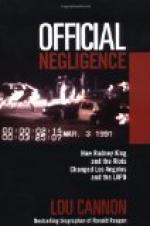
Early on March 3, 1991, four Los Angeles policemen, Stacy Koon, Ted Briseno, Lawrence Powell, and Timothy Wind, conducted a traffic stop of a car driven by Rodney King. When King stepped out of the car, an officer fired a 50,000 volt Taser electric dart gun, similar to a stun gun, at him. Thereafter, the police officers reportedly hit King with their batons between 53 to 56 times. As the result of the beating, King suffered serious injuries, including several broken bones.

A private citizen recorded the entire incident on video and later sold it to a local television news station. The local news station, in turn, sold a copy to Ted Turner's Cable News Network headquartered in Atlanta, Georgia. In the wake of repeated nationwide broadcasts of the beating, the four officers involved in the incident faced assault charges in state court in California.

Remarkably, in the state criminal trial, a jury found all four officers not guilty of the charges. A widespread riot broke out in Los Angeles. Within just hours of the verdict's announcement, people protested in the streets and reportedly burned, looted, and terrorized the entire city. The protest was considered a race riot, due to the fact that King was African American and the police officers accused of beating him were all Caucasian. The popular belief that the beating racially motivated was validated by the fact that transcripts of communications from the police cruiser in which the officers made several racial slurs both before and after the beating.

In a civil trial related to the beating, a jury awarded King $3.8 million in damages. King reportedly used some of the money to create a recording company. He also has stated that he wanted to become involved in helping minority juveniles to overcome racial problems.

Later, Stacy Koon and Lawrence Powell were convicted in a federal court for violating King's civil rights during the arrest. Under the Federal Sentencing Guidelines, the two officers faced a 70 to 87-month term of imprisonment. Despite this sentencing range, however, United States District Judge John Davies sentenced them to a 30-month term. The sentencing judge chose to depart from the guideline because King resisted arrest and, thus, contributed to the beating. The judge also reduced the sentences based upon the fact that the officers faced charges in connection with the incident in both state and federal court.

Since this incident, the city has sought to improve. For example, the Los Angeles Police Department changed the racial composition of its personnel. In 1991, the department had a non-minority population of 61.3 percent, as opposed to 50 percent in July of 1997. Furthermore, during the same time, the number of female police officers, who are said to be less prone to violent behavior, rose nearly 5 percent. To further combat the possibility of future police misconduct, in the wake of the King beating, all citizen complaints concerning officer conduct are sent to an inspector general, who investigates police conduct. Moreover, the city established a civilian body the Police Commission, which is comprised of nearly 9,500 members. Its duty is to oversee the activities of the department.

After receiving national media attention in 1991, King made the headlines once again in subsequent years for various arrests in California. In 1997, King served a three-month term of imprisonment for a domestic violence conviction. He was also arrested for soliciting a prostitute and drunk driving. In March of 1999, King turned himself in to police officers in San Bernadino County in California due to charges of domestic abuse and vandalism. The charges against King arose in connection with a domestic dispute involving King's sixteen-year-old daughter.

This section contains 604 words
(approx. 3 pages at 300 words per page)
Copyrights
Rodney G. King from World of Criminal Justice. ©2005-2006 Thomson Gale, a part of the Thomson Corporation. All rights reserved.
Follow Us on Facebook
Homework Help