
 Print
Print Word
Word PDF
PDF|
This section contains 2,657 words (approx. 9 pages at 300 words per page) |

|
Encyclopedia of World Biography on Qianlong
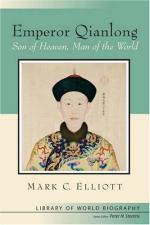
Qianlong (1711-1899) was the emperor of China and an ideal Confucian ruler during the height of the last dynasty, the Qing (Ch'ing).
Qianlong (Ch'ien-lung, Hung-li) was born into the Aisin Gioro clan of the Manchu people, a semi-nomadic race living in Manchuria. During the closing years of the Ming dynasty (1368-1644), the Aisin Gioro clan, led by the great warrior Nurhaci (1559-1626), consolidated power in Manchuria and northern China. Weakened by corruption and economic decline, the Ming presented an irresistible target to the Manchus, and in 1644 they conquered the Ming capital at Beijing (Peking) and proclaimed the last of the Chinese dynasties, the Qing (Ch'ing; 1644-1911).
The Chinese political system was dominated by an all-powerful emperor who passed on the throne to his descendants. Each period occupied by one such family is termed a "dynasty." The Manchus had long lived in close proximity to the Chinese and understood...
|
This section contains 2,657 words (approx. 9 pages at 300 words per page) |
|



