
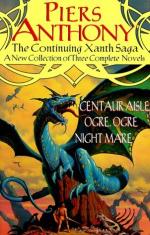
Piers Anthony is the pen name of Piers Anthony Dillingham Jacob, an Englishman who became an American citizen in 1958. "My major motivation as a writer," he observes, "has been my inability to quit writing, and my dissatisfaction with all other modes of employment." As a result of this focusing of energies, Anthony has been a veritable writing machine in recent years, authoring or coauthoring twenty-four novels since 1967. Born in Oxford, England, Anthony was brought to the United States as a child, celebrating his sixth birthday on board a ship. He found his early schooling in this country unpleasant, but he thoroughly enjoyed college. In 1956 he earned his B.A. from Goddard College, submitting as his creative writing thesis his first science-fiction novel. He married Carol Marble on 23 June 1956 and later served in the army from 1957 to 1959. Anthony's moral convictions made military service difficult for him, and, as he says, he "barely made it through basic," being a "pacifistically inclined vegetarian." He continued to write without success until the publication in 1962 of "Possible to Rue" in the April 1963 Fantastic. After receiving a teaching certificate from the University of South Florida in 1964, he pursued a variety of occupations, including those of English teacher, technical writer, and free-lance writer. But none of these satisfied him, and he began to devote his entire energy to writing. In 1967 he published his first novel, Chthon , the story of young Anton Five and his fellow prisoners in the garnet mines on the planet Chthon. Their plight is symbolically that of humanity in general, but the hero's initiation and escape adumbrate possibilities for human redemption. During this same year Anthony's Sos the Rope, a revised segment of his B.A. thesis, won the $5000 prize jointly sponsored by Pyramid Books, the Magazine of Fantasy and Science Fiction, and Kent Productions.
Publication became easier at this point in Anthony's career, and Sos the Rope was only one of three books published in 1968. In The Ring he again makes use of the youthful hero in quest of justice and vengeance, this time on an Earth ruled by the morally questionable "Ultra Conscience." The enslaving Ring of the novel's title introduces an important moral question in Anthony's fiction, for the Ring "makes a man a pacifist when the world is a battlefield." For Anthony, the will to moral activism is one of the distinctive marks of being human, and pacifism can be a negative quality when it is used as a facade for moral complacency, be it in speculative fiction or international politics. In Anthony's best fiction, questions of man's place in the ecology of the natural universe blend with considerations of the individual's role in providing satisfactory and humane answers. Thus in Omnivore, the third of the novels published in 1968, the reader is introduced to the trio of Cal (a superintellectual type), Veg (a strongman vegetarian), and Aquilon (a beautiful female artist). Sent to the planet Nacre to explore a jungle of multiform mushrooms, the group establishes contact with sentient fungoid life forms, the Mantas, which become a threat to Earth when the trio returns with them. The adventures on Nacre are set within the frame of an official investigation of the group by the superhuman government agent Subble, and the emotional ties among the heroes evolve along with their growing awareness of the cold viciousness of an Earth government that would sacrifice human lives in the paranoid attempt to destroy the imported aliens.
Anthony's next novel, considered his best by many readers, was Macroscope (1969). The mechanical invention of the title is a device that permits man to see the entire continuum of space and time. Not only are the secrets of the universe dissolved, but the innermost recesses of the individual consciousness are revealed. The novel focuses on the effect such a machine could have on a humanity that finds itself diminished in relation to the vastness of the universe; in doing so, it becomes an allegory on the fate of the individual diminished and possibly destroyed by mass society.
In Orn (1970) the heroes of Omnivore reappear and are transported to a prehistoric world in an age similar to the Paleozoic on Earth. Although constantly threatened by shifting land masses, erupting volcanoes, and massive tidal waves, they come to prefer the honest wildness of this world, which they call Paleo, to the deviousness of their own. The symbol of the innocent wildness of this world is Orn, a great noble bird doomed to extinction at the hands of the governmental agents who will follow the three explorers. Moved by what they see, the three protagonists decide to protect Paleo, and though ultimately unavailing, their attempts to do so establish them as ecologically humane, linked with the natural universe. It is in this novel that the predatory habits of man and animals are explored and differentiated most fully. The phrase "man as omnivore" becomes a motif in the novel, and man is eventually defined as more dangerous in his wanton destruction of nature than the less calculating beast who kills in moderation and out of necessity.
The thematic concerns of Anthony's fiction are often reflections of his own ardent vegetarianism. His contribution to Harlan Ellison's Again, Dangerous Visions (1972), for example, was a story entitled "In the Barn," in which female humans on an alien planet are kept as animals, as "cows" for giving milk. The story makes its point through a device that is hardly original (man is to alien as beast is to man), but the collapsing of the distance between human and nonhuman, between sentient and beastly, is nevertheless effective.
In 1972 and 1975 respectively, Var the Stick and Neq the Sword appeared to complete the trilogy begun with Sos the Rope . Collectively titled Battle Circle (1978), these books are set in a postholocaust America reduced to nomadic barbarians and an isolated underground vestige of the once powerful technological society.
In Ox (1976), Anthony returned to the adventures of Cal, Veg, and Aquilon, who are this time trapped in alternate dimensions of time and space along with their friends the Mantas from Nacre and a superwoman government agent, Tamme. This book reads a bit more slowly than its predecessors, and the sections featuring the creature Ox are a bit dense. But the novel is thematically tied to Anthony's other works by its concern with man's role in the natural world. Anthony places more emphasis on the fantastic in A Spell for Chameleon (1977) and The Source of Magic (1979), works that are basically adolescent fare, complete with witches, magicians, and evil spells. Such work does, however, prove Anthony's ability to entertain on the strength of his vivid imagination.
The Cluster,Chaining the Lady, and Kirlian Quest all appeared in 1978. Together they compose the Cluster trilogy, a space opera of galactic conquest on a grand scale, which seems to lead into the more recent Tarot trilogy, God of Tarot (1979), Vision of Tarot (1980), and Face of Tarot (1980). But whereas the Cluster trilogy is galactic in scale, God of Tarot takes as its theme questions of individual belief. Much of the quest here is an internal one as Brother Paul of the secular Holy Order of Vision is sent to the planet Tarot to investigate the strange tarot animations which may represent manifestations of the deity. The question becomes complex as Brother Paul reaches the planet and realizes that the colonists are religiously fragmented, segregated into many sects, each of which professes worship of a different god. Paul's journey is both inward and outward as he finds companions in his quest, confronts temptations, fails and recovers, and finally faces his own personal hell.
By Anthony's own admission, the Tarot trilogy is complex and a bit confusing, "and some scenes may be offensive to certain readers." Yet Anthony is not the author to sacrifice his artistic purpose to arbitrary convention; that would be literary pacifism. There is a rationale for this complexity and the offensiveness: "It is difficult," says Anthony, "to appreciate the meaning of the heights without first experiencing the depths." With the Tarot trilogy, it seems, Anthony has again returned to the serious science fiction grounded in personal conviction that has always been his forte, and readers may expect much from works to come.
This is the complete article, containing 1,385 words
(approx. 5 pages at 300 words per page).

