BookRags.com Literature Guides Literature
Guides
Criticism & Essays Criticism &
Essays
Questions & Answers Questions &
Answers
Lesson Plans Lesson
Plans
My Bibliography Periodic Table U.S. Presidents Shakespeare Sonnet Shake-Up
Research Anything:        
History | Encyclopedias | Films | News | Create a Bibliography | More... Login | Register | Help

Search "Peter Ludwig Berger"

Biographies Navigation
Not What You Meant?  There are 38 definitions for Berger.

Peter Ludwig Berger Biography

Print-Friendly  Order the PDF version  Order the RTF version
About 2 pages (684 words)
Peter L. Berger Summary

Bookmark and Share Know this topic well? Help others and get FREE products!
Name: Peter Ludwig Berger
Birth Date: March 17, 1929
Place of Birth: Vienna, Austria
Nationality: Austrian
Gender: Male
Occupations: sociologist

World of Sociology on Peter Ludwig Berger

Since the publication of his widely read The Sacred Canopy in 1966, sociologist Peter L. Berger has been known as one of the most interesting and often controversial writers on the sociological aspects of religion, economics, and modern society. Berger was born on March 17, 1929, in Vienna, Austria, the son of George William and Jelka (Loew) Berger. In 1946 he emigrated to the United States and in 1952 became a naturalized citizen. On September 28, 1959, he married Brigitte Kellner. They had two sons, Thomas Ulrich and Michael George. Berger received a Bachelor of Arts degree from Wagner College in 1949. He earned his Master of Arts and Doctor of Philosophy degrees from the New School for Social Research in 1950 and 1954, respectively.

In 1954, Berger began his career as a sociologist at the University of Georgia, Columbus. Over the next 25 years he held positions at numerous universities, including Evangelical Academy in Bad Boll, Germany, from 1955-1956, Women's College of the University of North Carolina (now University of North Carolina at Greensboro) from 1956-1958, Hartford Seminary Foundation in Hartford, Connecticut, from 1958-1963, New School for Social Research in New York City from 1963-1970, Rutgers University from 1970-1979, and Boston College from 1979-1981. In 1981 Berger became professor at the University of Boston.

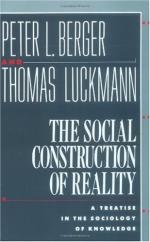
Berger has written over a dozen books, all of which have focused primarily on the sociology of religion and sociological theories pertaining to economic development. In The New York Times Book Review, Eleanor Munro refers to Berger's The Social Construction of Reality, (with Thomas Luckmann) (1966), The Sacred Canopy, (1967), and The Heretical Imperative (1979) as "milestones in the study of the life of ideas in contemporary society." Later works of note include The Capitalist Revolution: Fifty Propositions about Prosperity, Equality, and Liberty (1986), A Rumor of Angels: Modern Society and the Rediscovery of the Supernatural (1990), and Redeeming Laughter: The Comic Dimension of Human Experience (1997).

Keenly interested in the role of religion in the public realm, Berger draws both praise and criticism for mixing a scientific approach with his religious beliefs. In A Far Glory: The Quest for Faith in an Age of Credulity, Berger argued, "If there is a true self, it can only be revealed as true in a transcendent frame reference." Believing that humanity is God's reflection in the world, Berger attempts to prove empirically that religion can provide true enlightenment beyond the simple, everyday experience.

Sharply critical of post-modern Christian institutions as being without substance, Berger, a Lutheran himself, insists that the world still yearns for a transcendental experience. In an interview with Christian Century, he explained, "I think what I and most other sociologists of religion wrote in the 1960s about secularization was a mistake. Our underlying argument was that secularization and modernity go hand in hand. With more modernization comes more secularization. It wasn't a crazy theory. There was some evidence for it. But I think it's basically wrong. Most of the world today is certainly not secular. It's very religious." While lauded by some for his determination to bring his faith along with his science, other critics dismiss Berger's Christian perspective as a fundamental betrayal of any plausible scientific method.

In 1985 Berger became the director of the Institute for the Study of Economic Culture (ISEC) at the University of Boston. This newly formed research center was created to systematically study the relation between economic development and sociological change on a global level. In a 1999 letter to "Friends of the ISEC," Berger explained the intent of the center's study at its inception. "There was indeed an underlying orientation to wit, to study the cultural foundations of capitalism free of the anti-capitalist ideology which at that time was still very prominent in academia." Following the work of Alexis de Tocqueville, Berger maintains that organizations that affect everyday life, which he calls intermediate or mediating institutions, such as schools, labor unions, and churches, make up the foundation of democracy. The subject of The Capitalist Revolution, Berger draws the conclusion that capitalism is the economic system that will cultivate the highest levels of civic virtue and liberty.

This is the complete article, containing 684 words (approx. 2 pages at 300 words per page).

View More Summaries on Peter L. Berger
More Information
  • View Peter Ludwig Berger Study Pack
  • 38 Alternative Definitions
  • Search Results for "Peter Ludwig Berger"
  • Add This to Your Bibliography
  • More Products on This Subject
    Peter L. Berger
    There is a continuum of values between the churches and the general community. What distinguishes t... more

    Peter L. Berger
    Peter Ludwig Berger (born March 17, 1929) is an American sociologist and Lutheran theologian well kn... more


    Ask any question on Peter L. Berger and get it answered FAST!
    Answer questions in BookRags Q&A and earn points toward
    discounted or even FREE Study Guides and other BookRags products!
    Learn more about BookRags Q&A
    Copyrights
    Peter Ludwig Berger from World of Sociology. ©2005-2006 Thomson Gale, a part of the Thomson Corporation. All rights reserved.

    Join BookRagslearn moreJoin BookRags


    About BookRags | Customer Service | Report an Error | Terms of Use | Privacy Policy