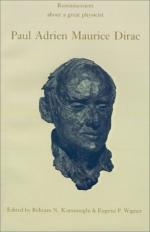
| Name: |
Paul Adrien Maurice Dirac |
| Birth Date: |
|
| Death Date: |
|
| Place of Birth: |
|
| Place of Death: |
|
| Nationality: |
|
| Gender: |
|
| Occupations: |
|
Dirac was born in Bristol, England, on August 8, 1902. His mother was English and his father was Swiss. Dirac earned a bachelor's degree in electrical engineering from the University of Bristol in 1921. When he was unable to find a job in engineering, he returned to Bristol to study mathematics. After two years at Bristol, he moved to St. John's College, Cambridge, from which he received a Ph.D. in mathematics in 1926.
Dirac's earliest success involved the application of quantum mechanics to electromagnetic theory. He applied the concept of "oscillators" to James Clerk Maxwell 's theory of electromagnetism to yield a new way of looking at electromagnetic phenomena, an approach that is now described as quantum field theory.
In 1929, Dirac began to look for a way of describing the properties of an electron by means of mathematical equations. The equations he developed, based only on the electron' s mass and charge, successfully predicted all of its other known properties. Two consequences of Dirac's theory that had special significance were the predictions of electron spin and positive electrons.
The concept of electron spin had been postulated by S. A. Goudsmit and G. E. Uhlenbeck in 1925. Goudsmit and Uhlenbeck devised the concept of electron spin to account for the splitting of spectral lines in the presence of a magnetic field. Although their suggestion solved the immediate problem of line splitting, they had no theoretical basis for this suggestion. Dirac's mathematical equations for the electron led automatically to the concept of electron spin. The Goudsmit-Uhlenbeck postulate now had a firm theoretical basis.
A second conclusion that resulted from Dirac's equations were that electrons can exist in two energy states, positive and negative. This aspect of Dirac's theory caused considerable discomfort among some of his colleagues for whom the concept of negative energy was difficult to accept.
To resolve this problem, Dirac suggested that the universe contains an infinite number of "holes," most of which are filled with negative-energy electrons. The only electrons we normally encounter are familiar positive-energy electrons, he said.
Dirac then went further to suggest that some holes remain unfilled. These unfilled holes correspond to the opposite of negatively-charged electrons. They can be thought of as positively-charged electrons, or positrons. It should be possible, Dirac said, for a positive-energy electron to jump into and fill a hole (a negative-energy electron). If that were to happen, both the electron and the hole (the positron) would disappear. Their energy would be released as photons.
In concrete terms, Dirac was suggesting that it should be possible to observe the interaction between a negatively-charged electron and its positively-charged counterpart. As a result of this interaction, both particles should be annihilated, leaving only a burst of energy behind. Within two years, Dirac's theory was confirmed by Carl David Anderson's discovery of the positron.
Dirac also suggested that a reverse process might be possible. That is, under appropriate conditions, one should be able to observe the conversion of energy (a photon) into an electron-positron pair. In 1933, P. M. S. Blackett and G. P. S. Occhialini announced that they had observed such an event. Cosmic rays passing through their cloud chambers apparently initiated fourteen cases of "pair formation," i.e., electron-positron production. The same year, Dirac was awarded the Nobel Prize in physics.
Dirac traveled widely and was visiting professor at a number of universities in the United States, including Michigan, Wisconsin, Princeton, and Miami. From 1932 to 1969, he held what is probably the most prestigious university appointment in science in the world, the Lucasian Chair of Mathematics at Cambridge. He died in Tallahassee, Florida, on October 20, 1984.
This is the complete article, containing 596 words
(approx. 2 pages at 300 words per page).
View More Summaries on Paul Dirac