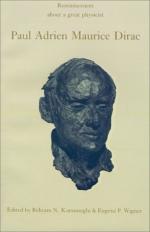
Paul Adrien Maurice Dirac was one of the leading theoretical physicists of the twentieth century. He made significant contributions to the early development of quantum mechanics, to theories of atomic structure and properties, and to quantum electrodynamics (the study of electrical interactions between atomic particles). Dirac successfully predicted the existence of the positron, i.e., a positively charged electron, and established the theoretical foundations for later discoveries related to antimatter. Dirac shared the Nobel Prize for Physics with Erwin Schrödinger in 1933 for his "discovery of new fertile forms of the theory of atoms and for its applications." Few of Dirac's theories were simple to grasp, and for that reason he had few students during his career.
Dirac was born in Bristol, England on August 8, 1902 to Charles Adrien Ladislas Dirac, a Swiss immigrant, and Florence Hannah (Holten) Dirac, a native of Britain. Dirac's father taught French at Merchant Venturer's Technical College, where Paul received his early education. As a youth, Dirac is said to have preferred to spend his time alone, taking long walks, and enjoying nature and gardening in preference to social activities. At school, he excelled in science and mathematics, but showed little interest in humanistic studies. Following his graduation in 1918 from Merchant Venturer's, Dirac enrolled in Bristol University, where he received a bachelor's degree in electrical engineering in 1921. At the time of his graduation, Britain was still in a postwar economic depression, so the young Dirac decided to return to school; this led to his accepting a two-year scholarship from the department of mathematics at Bristol University.
When Dirac's scholarship ran out at Bristol University, he enrolled as a research student in mathematics in St. John's College at Cambridge University. There, Dirac discovered in class and through his reading the work of many of the then leading atomic theorists, including Niels Bohr, Max Born, Arnold Summerfeld, and Werner Heisenberg, some of whom paid visits to Cambridge.
Sometime around 1924, Dirac made the statement at an academic tea party that any really interesting mathematical theory should have an application in the physical world. This idea was to evolve into Dirac's methodology for doing physics: find a beautiful mathematical theory and try to connect it to the physical world.
Dirac published his first research paper in 1925, and earned his Ph.D. in physics (at Cambridge University, theoretical physics was a discipline with the mathematics department) one year later by writing a thesis that elaborated quantum mechanic concepts originally developed by Werner Heisenberg.
In 1926, Dirac traveled to Copenhagen, where he met with Niels Bohr. One year later, he moved to Göttingen, where Max Born, J. Robert Oppenheimer, James Franck, and Igor E. Tamm were conducting research. When he returned to Cambridge, he was elected a fellow at St. John's College.
During the winter of 1927-8 at Cambridge, Dirac attempted to make improvements in Schrödinger's wave equation. Schrödinger's theory attempted to explain the behavior of an electron in an atom at the expense of ignoring relativistic effects, and Dirac set out to more completely describe the electron's behavior based only on that particle's mass and charge. Dirac succeeded in accurately predicting the spin angular momentum of the electron, its magnetic moment, and other properties as confirmed by later experimental measurements.
While working with his equations for the electron, Dirac discovered that his theory actually allowed for the existence of a positively charged electron, besides the already known negatively charged one. He also provided a road map for experimentalists to help them search for this particle, predicting that it would always be produced in connection with a negatively charged electron and in such a way that the positive and negative electrons would annihilate each other, producing chargeless photons. This particle, later named the positron, was discovered in 1932 by an American physicist, C.D. Anderson.
By extending this theory, Dirac was also able to predict the existence of other types of antimatter, including the antiproton and antineutron, which were also later observed experimentally. Dirac's ideas were to prove essential to later investigations in particle physics.
In 1929, Dirac was appointed university lecturer and praelector at St. John's. Because this post had few regular duties associated with it, Dirac was able to devote his time to research, writing, and travel. In the same year, he spent brief periods teaching at the University of Michigan and the University of Wisconsin. Returning to England by way of Japan and Siberia, Dirac reached Cambridge in 1930, and found himself elected to the Royal Society. His classic text, The Principles of Quantum Mechanics, was published the same year. In 1932, he was appointed Lucasian Professor of Mathematics at Cambridge, a post previously held in the seventeenth century by Isaac Newton.
In 1934, Dirac once again visited the United States, this time spending most of the 1934-5 academic year at the Institute for Advanced Studies at Princeton University. There, he met his future wife, Margit Wigner (the sister of physicist Eugene Wigner), whom he married in London three years later.
Unlike many of his colleagues, Dirac was not directly engaged in war-related work during World War II. Remaining at Cambridge during the war, Dirac did participate in government projects related to atomic energy, however. A particular interest of his was the separation of uranium isotopes, but none of his ideas ended up being used in later weapons development programs.
In 1969, Dirac retired from his academic position at Cambridge, and relocated to the United States. After a brief stay at the Center for Theoretical Studies at the University of Miami, he accepted an appointment as professor of physics at Florida State University in Tallahassee in 1972. For the next decade, he continued to travel, write, and lecture. His health began to deteriorate in 1982, and he died in Tallahassee on October 20, 1984.
This is the complete article, containing 956 words
(approx. 3 pages at 300 words per page).