
BookRags.com Literature Guides Literature Guides Criticism/Essays Criticism/Essays Biographies Biographies My Bibliography Periodic Table U.S. Presidents Shakespeare Sonnet Shake-Up
Research Anything:        
History | Encyclopedias | Films | News | Create a Bibliography | More... Login | Register | Help

Search "Pär Fabian Lagerkvist"

Biographies Navigation

Pär Fabian Lagerkvist Biography

Print-Friendly  Order the PDF version  Order the RTF version
About 3 pages (880 words)
Pär Lagerkvist Summary

Bookmark and Share
Name: Pär Fabian Lagerkvist
Birth Date: May 23, 1891
Death Date: July 12, 1974
Place of Birth: Växjö, Sweden
Nationality: Swedish
Gender: Male
Occupations: author

Encyclopedia of World Biography on Pär Fabian Lagerkvist

The Swedish author Pär Fabian Lagerkvist (1891-1974) was concerned with the meaning of life in a world without God and the existence of good and evil in such a world. Leif Sjöberg, in Pär Lagerkvist summarized the man: "Pär Lagerkvist more vigorously than any other professional writer explored religious concerns of both the modern heretic, influenced by modern science, and the modern brooder-searcher, an alienated outsider, desperately wanting to believe in traditional values. Persistently he came out as a nonbeliever, yet always with other possibilities open." In 1951 the Swedish Academy of Letters honored him with the Nobel Prize for literature.

Pär Lagerkvist was born on May 23, 1891, in Växjö, Småland, the youngest of seven children in a traditional and deeply religious family. His father, a railroad employee, refused to join his trade union because he believed that it contradicted God's established order. Despite his parents' devout beliefs and daily readings from the bible at home, Lagerkvist developed an alternative view of religion at a tender age, becoming in his own words, "a believer without faith, a religious atheist." He formed a group called "The Red Ring" with four friends and they discussed topics such as religion, anarchy, socialism, and evolutionism. Darwin's Origin of Species profoundly influenced the young group; Lagerkvist later wrote that it disturbed, "the very foundation of the transcendental view of the world."

Proposed a Simple Approach to Writing

Between 1911 and 1912 Lagerkvist studied the history of art at the University of Uppsala, but he was not satisfied and turned to writing. In 1912 he published his debut work, entitled Human Beings, but it was his next publication, Word Art and Pictorial Art that established him on Sweden's literary scene as a young writer with evolutionary ideas. He criticized contemporary Swedish literature for its lack of integrity and commercialism and prescribed both a Cubist theoretical approach to writing and a learning of the great ancient works. He propounded simplicity, writing that authors should use, "simple thoughts, uncomplicated feelings in the face of life's eternal powers, sorrow and joy, reverence, love, and hatred, expressions of the universal which rises above individuality."

Lagerkvist's Work

His early work--Anguish (1916; poems), Chaos (1919; poems, stories, and the play The Secret of Heaven), and Theater (1918; three plays)--evokes in powerful expressionistic images man's cosmic loneliness and his fear of life and death in an indifferent world. In two important essays on literature during this period, he attacks the prevailing psychological realism and calls for new literary forms more suited to the modern situation.

In the early 1920s Lagerkvist passed through a brief period of reconciliation to life, reflected especially in the remarkable story The Eternal Smile (1920). This mood did not last long, however, as seen in the play The Invisible One (1923) and the nightmarish stories in Evil Tales (1924). In 1925 appeared Guest of Reality, a novel about childhood, one of the few glimpses Lagerkvist gave into his life.

A new stage in Lagerkvist's development began with The Triumph over Life (1927), where in visionary passages he proclaims his philosophy. He rejects "life"--biological life--and declares his faith in the "divine," which consists in man's restless search for meaning, goodness, and justice. Like Albert Camus after him, Lagerkvist advocates "rebellion" against despair as a creative act in the face of life's incomprehensibility. In the 1930s Lagerkvist's work deals with the growing totalitarian threat in Europe. The most important of his works in these years are the play The Hangman (1933), the humanistic manifesto The Clenched Fist (1934), and a play about political assassination, The Man without a Soul (1936).

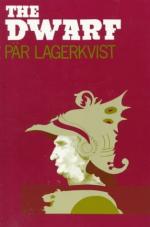
After World War II Lagerkvist turned often to the novel form. The Dwarf (1944) takes place in the Italian Renaissance, yet is also about World War II and about man in all places and times. With Barabbas (1950), perhaps his most famous work, he began a series of novels dealing with man's encounter with the divine and his quest for understanding and salvation. This theme was continued in The Sibyl (1956), The Death of Abasuerus (1960), Pilgrim at Sea (1962), and The Holy Land (1964). His final novel, Mariamne (1967) makes use of a symbolic constellation that appears often in his books, here the brutal, power-sick Herod and his wife Mariamne, whom he must kill when he realizes he can never understand the love she represents.

Lagerkvist's strength lies in his ability to create memorable figures that symbolize eternal forces in man: the hangman, the dwarf, and Herod are men in despair; Barabbas, the sibyl, and Tobias represent the seekers who have experienced the divine and can never be at peace again. Mariamne, the hangman's wife, and Asak in Barabbas, who do good without question, can be obliterated by man's brutality or by life's indifference but represent an enduring quality that Lagerkvist believes will never perish.

Received the Nobel Prize for Literature

In 1951 the Swedish Academy of Letters awarded Lagerkvist the Nobel Prize for literature, explaining that it gave the prize, "For the artistic power and deep-rooted independence he demonstrates in his writings in seeking an answer to the eternal questions of humanity." Never a public man, Lagerkvist said only a few words to the public, "I have no particular message; it is all in my books." After suffering a stroke the week before, he died on July 12, 1974.

This is the complete article, containing 880 words (approx. 3 pages at 300 words per page).

View More Summaries on Pär Lagerkvist
More Information
  • View Pär Fabian Lagerkvist Study Pack
  • Search Results for "Pär Fabian Lagerkvist"
  • Add This to Your Bibliography
  • More Products on This Subject
    Par Lagerkvist
    The position of Pär Lagerkvist as one of the leading Swedish writers of the twentieth century ... more

    Lagerkvist, PÄR
    (born May 23, 1891, Växjö, Sweden—died July 11, 1974, Stockholm) novelist, poet, dr... more


    Copyrights
    Pär Fabian Lagerkvist from Encyclopedia of World Biography. ©2005-2006 Thomson Gale, a part of the Thomson Corporation. All rights reserved.

    Works by Author
    Join BookRagslearn moreJoin BookRags


    About BookRags | Customer Service | Report an Error | Terms of Use | Privacy Policy

