|
This section contains 1,243 words (approx. 5 pages at 300 words per page) |

Authors and Artists for Young Adults on P. Craig Russell
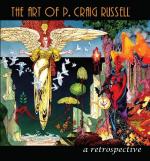
Illustrator and graphic novelist P. Craig Russell has blended a love of classical opera with artwork noted for its lush line, attention to detail, and classical themes to create graphic-novel adaptations of musical works ranging from The Magic Flute by Wolfgang Amadeus Mozart to Richard Strauss's Salomé. Russell's two-volume treatment of Wagner's Ring of the Nibelung trilogy was a massive five-year project of love that garnered Russell an Eisner Award and further critical acclaim. Additionally, his adaptations of fairy tales by nineteenth-century Irish writer Oscar Wilde and of stories by Rudyard Kipling have won awards and a readership that stretches beyond the usual comic-book audience. Russell has also contributed artwork to more typical superhero comic books, starting out with Marvel Comics on "Batman" and "Dr. Strange." "So many stories, so many pictures, so few hours in the day," Russell once commented.
From Superheroes to Sopranos
Born in Ohio in 1951, Russell attended the University of Cincinnati, where he earned a B.F.A. in painting and illustration in 1974. By this time he was already contributing artwork to Marvel Comics, working on the Dr. Strange Annual as well as the "Killraven" comic books. Both titles deal in fantasy worlds; in "Killraven" he illustrated the eponymous gladiator who does battle with the Martians in a world inspired by that of H. G. Wells in War of the Worlds. He also inked various "Batman" episodes in the early 1970s.
Working for Eclipse Comics, Russell began to turn his attention to artistic themes with "Dance on a Razor's Edge," a short story about the ritual suicide of Japanese writer Yukio Mishima. In 1976 he adapted his first opera, Parsifal, Wagner's final work. In 1978 he created a comic book series dealing with one scene from The Ring of the Nibelung; this was enough to set him on a quarter-century quest to complete the entire "Ring" sequence.
"I was always into classical music," Russell noted on Horizons Online. Throughout high school he studied piano and formed an early love of opera. After working several years at Marvel, he decided to do "opera comics because I wanted to do books that were more in line with the things I was interested in. Typical superhero books didn't interest me." He began looking for libretti with "literary meat," ones that had a good, strong story. Meanwhile, he was also doing more traditional fantasy artwork, as in "Elric: The Dreaming City" and "Elric of Melnibone," both adapted from Michael Moorcock's novel Elric, about an albino warrior.
Working with Eclipse Comics, Russell published a string of comic books based on operas, choral, and orchestral works. His "The Drinking Song of Earth's Sorrow," a four-page tale, was based on music for orchestra by the Austrian composer Gustav Mahler, as was "Unto This World," a song cycle. With Pelleas and Melisande, he adapted the symbolist opera of Claude Debussy, based on the story by Maurice Mäterlinck. A story of doomed love, the tale gave Russell vent to use his art nouveau line, as did Salomé, his adaptation of the Richard Strauss opera. With this adaptation, Russell was heavily influenced by the "signature theme," as he noted in Horizons. Ariane and Bluebeard is based on another opera that was adapted from a Mäterlinck story.
With The Magic Flute, Russell tackled the tale of Prince Tamino, who is given a magical flute by the queen of the Night in order to rescue her daughter from the supposed villain, Sarastro. In actuality, Sarastro turns out to be a good man, the queen the villain. Steve Raiteri, reviewing the 2003 publication of the combined series as The Magic Flute, called Russell's artwork "marvelous," noting that he blends "realistic figures with decorative backgrounds." A contributor for Publishers Weekly, reviewing the graphic-novel edition, had high praise for the book: "Sure and confident, Russell's art switches from tense action sequences to slapstick without missing a beat." The same reviewer thought Russell also struck "just the right tones" with his dialogue, and concluded that this "classic adaptation displays the artist's skill at both writing and illustrating."
Fairy Tales, Mowgli, and the Nibelung
In 1992 Russell brought out his first volume of Fairy Tales of Oscar Wilde, including the stories "The Selfish Giant" and "The Star Child." Both of these "adeptly capture Wilde's ability to bring a gentle, unexpected note of pathos" to the fairy tale, according to a reviewer for Publishers Weekly. Here Russell's pre-Raphaelite and art nouveau styles are in evidence, as well as a cartoon-like feel. For the Publishers Weekly contributor, "Russell matches Wilde's literary skills with his estimable artistic talent." The third volume of The Fairy Tales of Oscar Wilde focuses on "The Birthday of the Infanta," telling of the birthday party of a spoiled princess and the dwarf who amuses her. Booklist's GraceAnne A. DeCandido praised Russell's "classic comics-graphic novel style," and concluded that "older children will appreciate the edgy story and the mouth-filling language as well as the format."
Russell has also adapted the tales of Rudyard Kipling in several volumes of the Jungle Book Stories, featuring the adventures of the young boy Mowgli. Among the tales included are "The King's Ankus, Red Dog," and "Spring Running," which follow the jungle youth from childhood to adolescence. But continually Russell comes back to his opera adaptations, as with the 1997 visioning of Leoncallo's The Clowns (I pagliacci), featuring a group of entertainers in nineteenth-century Italy and their play-within-a-play of a cheating wife.
With the two volumes of The Ring of the Nibelung, Russell completed a massive, 424-page effort that retells Richard Wagner's "Ring Cycle" of operas, Das Rhinegold, Die Valkyrie, Siegfried, and Die Götterdämmerung or Twilight of the Gods. This tale of the cursed ring taken from the Rhine maidens follows the efforts of Siegfried to save civilization. For Devin Leonard, writing in Fortune, Russell's adaptation is "a terrific road map if you're visiting Wagner country for the first time." Similarly, Jody Sharp, writing in School Library Journal, found that Russell "has brilliantly adapted" Wagner's work.
Finishing the Wagner project in 2002, Russell took on smaller books for a time, gathering some of his earlier short stories in Isolation and Illusion: Collected Short Stories, 1977-1997. Reviewing this work, Booklist's Ray Olson noted that Russell "has a sinuous line few can match, a refined eye for shading and coloration, a flair for dramatic composition, and figure-drawing skills for days." Russell has also collaborated with writer Neil Gaiman, of "Sandman" fame, on several volumes, including the 2002 Murder Mysteries, a tale of two connected deaths, one of long ago in Silver City, and another contemporary one in Los Angeles. Booklist's Olson thought that Russell "does the heavy lifting" in this adaptation, and that his "highly polished mainstream-comics draftsmanship, coloring, and composition fit Gaiman's elegantly ambiguous story just about perfectly." Similarly, a Publishers Weekly reviewer concluded that Russell's "crisp and vividly rendered drawings capture the haunting sense of loss and isolation Gaiman expresses in this mythic tale of love and jealousy."
"I believe the graphic story art form to be one of the best kept secrets of the day," Russell once commented. "I particularly like doing adaptations. The challenge, like that of the screenplay (from novel to film), is to deconstruct a piece and then to reconstruct it in another form, exploiting the possibilities and meeting the demands of that new form, while remaining true to the spirit of the original. It takes a jigsaw puzzle mind combined with a love of imagery to make it work. I can't imagine being in any other field."
|
This section contains 1,243 words (approx. 5 pages at 300 words per page) |