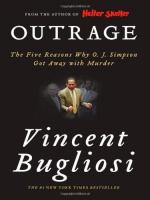
Orenthal James Simpson (O.J.), rose through college to become a star professional football player and national icon. He took his fame from sports to Hollywood where he continued in a successful career of acting in both movies and advertising. Unfortunately he gained the biggest audience of his life after the double murder of his ex-wife, Nicole Brown Simpson, and her male friend, Ron Goldman. O.J. was viewed as the only suspect in this crime, and he was found not guilty. In a "media expose" of the U.S. justice system, the trial showcased the best defense money could buy. It also showed a new side of O.J. Simpson, a possessive and erratic spouse abuser.
O.J. Simpson was born on July 9, 1947 in San Francisco, California, the third of four children. At age two he contracted rickets, an often-disabling disease, and was forced to wear leg braces for three years. Adolescence was tough as well; he was cut from his youth football team, became a gang member, and spent time in the San Francisco Youth Guidance Center. He returned to football, doing well in high school before his standout career at the University of California. While he played running back in college his notable accomplishments included being named All American in 1967 and in 1968 named the Heisman Trophy winner as the best college football player in the United States. He was the number one pick in the 1969 National Football League draft. O.J. spent most of his professional football career with the Buffalo Bills. He set numerous records, and in 1973 he became the first player to gain over 2000 yards in a single season.
In 1967, O.J. married Marguerite Whitley his 18-year-old sweetheart. They had three children. He separated from Marguerite in October of 1978. Simpson's youngest daughter from his first marriage, Aaren, drowned as an infant on August 18, 1979 in a pool while in the custody of Marguerite. O.J. blamed Marguerite for her death.
Simpson met his second wife to be in June 1977. Nicole Brown was a recent high school graduate and was working as a waitress when she first met O.J. Simpson. They married in February 1985 and had two children. Their marriage was often turbulent, and police were frequently called to disturbances at the Simpson estate. On New Year's Day 1989, one of the most publicized incidents of domestic violence occurred between them at their home. Police responded to a 911 call and found Nicole badly beaten, half-naked and hiding behind some bushes in front of the house claiming "he's going to kill me." Simpson was arrested and, despite Nicole's willingness to drop the charges, was convicted of spousal abuse.
Nicole and O.J. separated in February 1992. In October of that year they were divorced. On October 25, 1993, Nicole again called 911 in reference to O.J. While living in her own condominium she told police, "He's back. I think you know whom I mean: O.J. Simpson." On June 12, 1994, Nicole was brutally murdered, nearly decapitated, along with her friend Ron Goldman near the entrance to her condominium. O.J. Simpson was the only suspect in the crime.
On June 17, 1994, O.J. Simpson was officially charged with two counts of murder in the Brown-Goldman murders. He refused to surrender and was declared a fugitive. Shortly after O. J. was discovered missing from his residence, the police located a white Ford Bronco being driven by one of Simpson's friends. The police observed O.J. sitting in the back seat with a gun pointed toward his own head. The whole world watched as a lengthy, slow speed police chase ensued. After over an hour of flight, O.J. turned himself over to authorities in the driveway of his home.
From his arrest until the conclusion of his trial O.J. spent a total of 474 days in police custody. The trial cost O.J. and the state of California millions of dollars. The media made a circus of the whole affair, and the country simmered as barely contained racism threatened to explode.
Judge Lance Ito, a former county prosecutor presided over the trial. Judge Ito was harshly criticized for his grandstanding and lack of control in the courtroom. His rulings were blamed for creating and promoting a television and media frenzy.
Marcia Clark was the assistant prosecutor in charge of the trial. Noted for her nimble mind and successes in the district attorney's office, she had never heard of O.J. Simpson until she was assigned to his case. After her initial trial preparation work started she declared O.J. an "unconvictable defendant" due to his hero status and the Los Angeles Police Department's early bungling of key matters and evidence.
Christopher Darden was the second prosecutor assigned to assist Clark with the trial. A competent young attorney, Darden feuded with the defense team, and his decision to make O.J. publicly try on the bloody glove found at the scene of the crime (against his superiors' advice) caused many critics to blame him for the not guilty verdict.
Noted attorney Robert Shapiro coached the O.J. Simpson "dream team" of attorneys. Johnnie L. Cochran, another high profile attorney, played the role of chief litigator. He was famous for the statement, "if the glove don't fit you must acquit" during his closing argument and for injecting racial issues into the trial. Other members of the now infamous "dream team" were F. Lee Bailey, Alan Dershowitz, and Barry Scheck.
Once the trial commenced it was obvious that errors had been made by the police in conducting the initial investigation. Trial records show that Simpson's property was entered without a search warrant, photographic evidence was lost or mislabeled, DNA evidence was possibly tainted due to poor collection/storage procedures, and the expert's testimonial conclusions were based on that bad data. It also became clear that one of the key detectives in the crime scene investigation, Mark Furman, was a racist who had committed perjury while testifying at trial. Thus the police themselves injected much reasonable doubt into a trial that many people believed should have been an open and shut case. Since a criminal trial requires proof beyond a reasonable doubt that a criminal is guilty and the jury was forced to choose between seemingly endless scientific testimony on tainted DNA and a lying policeman, the ending was a foregone conclusion, not guilty.
This is the complete article, containing 1,046 words
(approx. 3 pages at 300 words per page).