
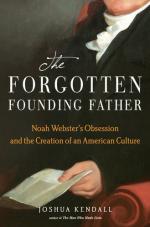
Noah Webster (16 October 1758-28 May 1843) is a name that Americans have regarded as synonymous with "dictionary" for over a century. Popular opinion of Webster not only exaggerates his influence on lexicography, but fails to understand that his real contribution was not to form and direct the course of the language itself but to mold and rationalize the attitudes Americans have toward their language. Websterian zeal for reform, specifically authoritarian linguistic reform, has embued us with a reverence for dictionaries, grammars, and the printed word unparalleled in civilization. Webster's experience during his life in Connecticut as a lawyer, teacher, journalist, lobbyist, and essayist shaped his career as a lexicographer. He felt that the survival of the new nation depended critically on the establishment of a universal and practical system of education, for which there were neither adequate teachers nor suitable textbooks. Webster set out to combine pedogogy and patriotism, drawing on native cultural resources for a grammar, reader, and speller. The latter was first published as The American Spelling Book (Hartford, Ct.: Hudson & Goodwin) in 1783, retitled The Elementary Spelling Book in 1829, but best known as "The Blue-Back Speller." Despite many pirated editions, it was Webster's only commercial success; estimates of its sales exceed 100 million. Webster's first dictionary, A Compendious Dictionary of the English Language (Hartford, Ct.: Hudson & Goodwin), appeared in 1806. The preface acknowledges that the work was "an enlargement and improvement" of John Entick's A New Spelling Dictionary, but Webster did make a full display of his notions of reformed spelling, and he did include a substantial number of American contributions to the word stock. But neither the Compendious nor Webster's masterpiece, his 1828 American Dictionary of the English Language (New York: S. Converse), represented any substantial advance in lexocographical method. Indeed, Webster's chief virtue was in the application, advocacy, and aggressive defense of his principles; his judgment, linguistic or otherwise, often bears little scrutiny.
Though by 1828 less convinced of the necessity for justifying American linguistic independence, Webster nonetheless followed Samuel Johnson's sentiment that "The chief glory of a nation is its authors," and liberally, but haphazardly, satisfied his patriotism by selecting illustrative quotations from American writings. He also continued to enter the characteristically American vocabulary, though in retrospect his coverage must be judged uneven. While retreating from his more radical spelling reforms, he retained his passionate dislike for silent letters; on the whole his spelling was still too innovative for the taste of even moderate contemporaries. Though eager to promote American pronunciations in place of what he felt were English or Anglophile affectations, Webster was often overtaken by provincialism: he lent his authority to his New England dialect at the expense of pronunciations at least as well sanctioned by contemporary usage. In etymology, Webster was abysmally ignorant of the philological advances being made by his European colleagues, and held to the already discredited Biblical account of the diversification of tongues. Though he claimed to know more than twenty languages, his puerile interpretations reveal his knowledge of some as quite rudimentary. The American Dictionary underwent several substantial modifications during the next generation, the first being the 1829 abridgement by Joseph E. Worcester. The two-volume format and the high price of the 1828 edition had met strong sales resistance, and the abridgment did little better. The subsequent commercial success of Worcester's own dictionary (1830) opened a permanent breach between the two lexicographers. After a bitter dispute over Webster's literary estate, George and Charles Merriam obtained the rights to the dictionaries and carried on an intense rivalry with Worcester until the 1864 Royal Quarto Edition of the American Dictionary (Springfield, Mass.: Merriam) appeared. The Royal Quarto dominated the market for the next quarter century, but it was a work from which everything characteristic of Webster himself had been systematically eliminated. The Merriam firm continues to publish dictionaries, and until the early 1950s retained commercial rights to the name Webster.
This is the complete article, containing 655 words
(approx. 2 pages at 300 words per page).

