
BookRags.com Literature Guides Literature Guides Criticism/Essays Criticism/Essays Biographies Biographies My Bibliography Periodic Table U.S. Presidents Shakespeare Sonnet Shake-Up
Research Anything:        
History | Encyclopedias | Films | News | Create a Bibliography | More... Login | Register | Help
Not What You Meant?  There are 21 definitions for Miramar.

Search "Najib Mahfuz"

Biographies Navigation
 

Najib Mahfuz Biography

Print-Friendly  Order the PDF version  Order the RTF version
About 4 pages (1,267 words)
Naguib Mahfouz Summary

Bookmark and Share
Name: Najib Mahfuz
Birth Date: December 12, 1912
Place of Birth: Cairo, Egypt
Nationality: Egyptian
Gender: Male
Occupations: novelist

Encyclopedia of World Biography on Najib Mahfuz

Najib Mahfuz (born 1912) was Egypt's foremost novelist and the first Arab to win the Nobel Prize in literature. He had wide influence in the Arab world and was the author from that area best known to the West in the latter half of the 20th century.

Najib Mahfuz was born in the popular quarter Hayy Al-Jamaliyya in Cairo, Egypt, on December 12, 1912, to a middle-class merchant family. During his high school years he began to read the Arabic classics as well as the Western ones that he could find in translation. He proceeded to major in philosophy at Cairo University, and after graduating in 1934 he worked his way up the bureaucracy as a civil servant. He continued to work until he retired as director of the Cinema Organization, after which he worked as a consultant to several governmental cultural organizations. He was a frequent contributor to the daily newspaper Al-Ahram, where most of his writings appeared in serial form before being published in book form. Mahfuz was married and the father of two daughters.

An avowed disciple of the pioneers of the literary Rennaisance of the early 20th century such as Al-Aqqad, Salama Musa, and Taha Husayn, Mahfuz--unlike his mentors and many of his peers--never studied abroad, and indeed infrequently traveled outside of Egypt. Therefore, his knowledge of the West and Western literary forms came primarily from his profuse readings. Mahfuz, who is sometimes referred to as the "Balzac of the Arabs," was an ardent admirer of the Russian classics. Tolstoy, Turgenev, and Dostoevsky were often quoted by him in interviews as the examples he would like to emulate.

Mahfuz's early writings have been categorized traditionally as historical in that he dealt with subjects inspired by ancient Egyptian history. In an interview to the literary magazine Al-Hawadess, Mahfuz corrected this misconception by saying that only one of the early three works--Kifah Tiba (The Struggle for Thebes, 1944)--was strictly a historical novel. The other two--Abath Al-Aqdar (The Meanderings of Fate, 1938) and Radobis (1943)--were fictional stories inspired by folk epics.

A new phase of realistic writings began with a series of novels that delved into more contemporary subject matter and characters. Al-Qahira Al-Jadida (New Cairo, 1945) ushered in the genre of novels that more specifically come to be associated with the author. Most of the novels after these bear names of the old-time quarters of Cairo, names that resonate with a continuous history of over a thousand years. Khan Al-Khalil (1946), Zuqaq al-Midaq (1947), and his trilogy, Al-Thulathia (comprising Bayn al-Qasrayn, Qasr al-Shauq, Al-Sukkariyya), recall throbbing arteries of a great city.

This epoch-making trilogy, considered his masterpiece and written between 1946 and 1952, traces the radical changes undergone by a Cairene bourgeois family dominated by the declining figure of its tyrannical patriarch, Ahmad Abd a-Jawad. In this trilogy, Mahfuz painstakingly follows the changes taking place in Egyptian society and identity through the lives of the members of this extended family. The cultural and ideological turmoil that Egypt experienced after the turn of the century came to a head by the end of World War II. It was masterfully handled by Mahfuz through his characters, who range in their ideologies from the extreme right fundamentalists of the Muslim Brothers to the extreme Leftists fighting British colonialism and seeking independence for a free Egypt. The trilogy was considered a distinctive contribution to world literature in that it was not an imitation of a Western model but a unique contribution of Egyptian genius. The trilogy was awarded Egypt's highest literary honor in 1957.

Al-Sarab (The Mirage, 1948) is generally looked upon as a turning point in Mahfuz's development. Here he probes into psychological considerations for the understanding of his characters' behavior. Bidaya wa Nihaya (The Beginning and the End, 1949) also belongs to this phase

In an area of the world where literacy is still not widespread, radio, cinema, and television play a crucial role in the education and entertainment of the people. Many of the writings of Mahfuz have been successfully adapted to the screen and stage. This enabled him to become widely known and admired throughout the Arab world. Mahfuz also wrote many scripts for works of other writers, which may perhaps explain the mastery of cinematic techniques that is manifest in his own writings.

Works Dealt With Philosophical Questions

Awlad Haritna (Sons of our Alley, 1967) augurs an era of neo-realism in which he questioned and probed ideas, concepts, and philosophies of the God-man relationship, good and evil, and life and death. These existential questionings are even more apparent in his short stories, which have been collected in several anthologies. His preoccupation with Sufi (Islamic mysticism) considerations and apparent discrepancies of 'ilm (knowledge) and iman (faith) are poignantly handled throughout his later writings, and specifically in his voluminous epic tale Al-Harafish. Mahfuz's later writings, such as Alf Layla wa Layla (A Thousand and One Nights, 1982), are modeled on its prototype. Al'Ai'sh fi al-Hakika (He Who Lives in Truth, 1985) was considered by him more as an historical novel than fictional writing.

Writings Encountered Controversy

His novels have often gotten him into trouble with authorities, both in his native land and elsewhere in the Arab world. The Children of Gabalawi (1959) was banned in Egypt because it was seen as offensive to Islam and considered blasphemous by many Muslims. In the 1960's Mahfuz found himself in trouble with the government because several of his novels were considered allegorical attacks on the administration of President Gamal Nasser. Because of his support for Egyptian President Anwar Sadat's peace treaty with Israel in 1979, Mafuz's writings were banned in many Arab countries during the 1980's, although the prohibitions were eventually lifted. Women often play a significant role in his novels, going beyond their traditional passive role in Egyptian society.

First Arab Wins Literature Nobel

In October of 1988 Mahfuz was awarded the Nobel Prize in literature, the first Arab writer--and second from the African continent--to be so rewarded. A modest man with a dry sense of humor, Mahfuz, according to the report in the October 14th edition of the New York Times, took his Nobel in stride. The citation from the Swedish Academy of Letters said his work was "now clearsightedly realistic, now evocatively ambiguous," to which Mahfuz commented, "Clarity is valuable, but ambiguity has its value too." Asked about his plans for spending the $300,000 prize money, New York Times reported that he looked at his spouse and replied, "That is my wife's job." Perhaps more than any other Arab writer, Najib Mahfuz has been the subject of scholarly study in the West. Since the 1970s master's and doctoral dissertations have been partially or wholly dedicated to the study of the short stories and novels, characters, and techniques of this writer.

In view of his own prior conflicts with Muslim leaders, it surprised many when, in a 1992 interview with the Paris Review Mahfuz criticized fellow author Salmon Rushdie for the latter's novel, The Satanic Verses. The novel had been condemned as blasphemous by many Muslims, and Iran's religious leader, the Ayatollah Khomeini, had offered a million-dollar reward for Rushdie's death. Mahfuz had previously defended Rushie, but in an interview with Charlotte El Shabrawy, he told her he had been unaware of the contests of Rushdie's novel. After Mahfuz, who had failing eyesight, had the book read to him, he said he was "appalled" by what he felt were the insults to Muslims and the Prophet Mohammed. While standing by his prior statements that Khomeini had no right to threaten Rushdie with death, Mahfuz said Rushdie "does not have the right to insult anything, especially a prophet or anything considered holy."

This is the complete article, containing 1,267 words (approx. 4 pages at 300 words per page).

View More Summaries on Naguib Mahfouz
More Information
  • View Najib Mahfuz Study Pack
  • 21 Alternative Definitions
  • Search Results for "Najib Mahfuz"
  • Add This to Your Bibliography
  • More Products on This Subject
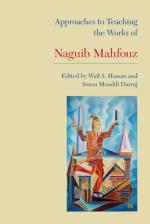
    Naguib Mahfouz
    Naguib Mahfouz is widely regarded as Egypt's finest writer. While his works remained largely unknow... more


    Copyrights
    Najib Mahfuz from Encyclopedia of World Biography. ©2005-2006 Thomson Gale, a part of the Thomson Corporation. All rights reserved.

    Join BookRagslearn moreJoin BookRags


    About BookRags | Customer Service | Report an Error | Terms of Use | Privacy Policy

