
 Print
Print Word
Word PDF
PDF|
This section contains 2,168 words (approx. 8 pages at 300 words per page) |

|
Encyclopedia of World Biography on Musa al- Sadr
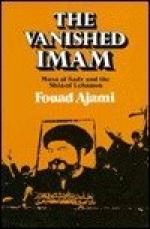
Musa al-Sadr (1928-ca. 1978), known as Imam Musa, was a Shi'ite Moslem religious and political leader who was instrumental in improving the lot of the ordinary Shi'ites in South Lebanon while reducing the power of the Shi'ite elites. Al-Sadr disappeared in 1978 under mysterious circumstances and is presumed dead.
Musa al-Sadr was born in Qum, Iran, in 1928, the son of an important Shi'ite Muslim religious leader, Ayatullah Sadr al-Din Sadr. He attended secondary and primary school in Qum and college in Tehran. He did not intend to study religion, but upon the urging of his father he discarded his secular ambitions and pursued an education in Islamic jurisprudence (figh). Initially, he studied in a Qum madrasah (religious school), and while still in Qum he edited a magazine, Makatib-i Islami (Islamic Schools), which is still published in Iran. One year after his father's death in 1953, he moved to Najaf, Iraq, where...
|
This section contains 2,168 words (approx. 8 pages at 300 words per page) |
|



