
| Name: |
Muhammad Iqbal |
| Birth Date: |
|
| Death Date: |
|
| Place of Birth: |
|
| Place of Death: |
|
| Nationality: |
|
| Gender: |
|
| Occupations: |
|
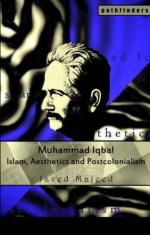
Muhammad Iqbal (ca. 1877-1938) was an Indian Moslem poet and political philosopher. His fame rests on both his poetry and his formulation of ideas that were influential in the creation of Pakistan.
Muhammad Iqbal was born in Sialkot, Punjab, probably in 1877, although there is some uncertainty about the year of his birth. He graduated from Government College, Lahore, in 1899 with a master's degree in philosophy. He taught there until 1905, while establishing his reputation as an Urdu poet. During this period his poetry expressed an ardent Indian nationalism, but a marked change came over his views between 1905 and 1908, when he was studying for his doctorate at Cambridge University, visiting German universities, and qualifying as a barrister.
The philosophies of Nietzsche and Bergson influenced Iqbal deeply, while he became extremely critical of Western civilization, which he regarded as decadent. He turned to Islam for inspiration and rejected nationalism as a disease of the West. He argued that Moslems must find their destiny through a pan-Islamic movement that ignored national boundaries. He also denounced the mystical trend of Indian Islam, blaming it for weakening the Moslem community and leading to its political downfall. These ideas found vigorous expression in the long poems Asrar-i-Khudi ( The Secrets of the Self) in 1915 and Rumuz-i-Bekhudi (The Mysteries of Selflessness) in 1918. These were written in Persian, not Urdu, presumably to gain his ideas an audience in the Moslem world outside India.
Iqbal was knighted by the British in 1922, and his fame drew him increasingly into public life. Although he was not an active politician, he was elected to the Punjab legislature in 1926, and in 1930 he was made president of the Moslem League. By this time the dream of a pan-Islamic world no longer appealed to him. His statement in his presidential address that the "final destiny" of Indian Moslems was to have a "consolidated Northwest Indian Moslem state" is regarded as one of the earliest expressions of the idea of Pakistan.
Becoming convinced that Moslems were in danger from the Hindu majority if India should become independent, Iqbal gave his powerful support to Mohammad Ali Jinnah as the leader of India's Moslems. In his last years Iqbal returned to Urdu as his poetic medium, publishing Bal-i-Jibril (Gabriel's Wing) in 1935 and Zarb-i-Kalim (The Rod of Moses) in 1936. They have been criticized as lacking the energy and inspiration of his early work. He died in Lahore on April 21, 1938.
This is the complete article, containing 409 words
(approx. 1 page at 300 words per page).
View More Summaries on Muhammad Iqbal

