BookRags.com Literature Guides Literature
Guides
Criticism & Essays Criticism &
Essays
Questions & Answers Questions &
Answers
Lesson Plans Lesson
Plans
My Bibliography Periodic Table U.S. Presidents Shakespeare Sonnet Shake-Up
Research Anything:        
History | Encyclopedias | Films | News | Create a Bibliography | More... Login | Register | Help

Not What You Meant?  There are 23 definitions for Ali.  Also try: Cassius or Muhammad or The Greatest or Cassius Marcellus Clay.

Muhammad Ali Biography

Print-Friendly  Order the PDF version  Order the RTF version
About 3 pages (954 words)
Muhammad Ali Summary

Bookmark and Share Know this topic well? Help others and get FREE products!
Name: Muhammad Ali
Variant Name: Cassius Cla
Birth Date: January 17, 1942
Place of Birth: Louisville, Kentucky, United States
Nationality: American
Ethnicity: African American
Gender: Male
Occupations: boxer

World of Criminal Justice on Muhammad Ali

In 1967, Muhammad Ali was stripped of his heavyweight boxing title for violating the Selective Service Act. As a Muslim, Ali refused to be inducted into the U.S. Army. He won back the title in 1974, and later became the first boxer to win the heavyweight championship three separate times. Some call him the greatest heavyweight boxer ever.

Born Cassius Marcellus Clay, Jr., in Louisville, Kentucky, on January 17, 1942, Ali began boxing at the age of 12. A white policeman in Louisville, Joe Martin, took an interest in the talented black youth and got him to work out in the city's Columbia Gym. Black trainer Fred Stoner took over and molded Ali into a powerful boxer with the grace and agility of a dancer. In 1960, Ali attracted national notice by winning the Amateur Athletic Union light heavyweight, Golden Gloves heavyweight, and the Olympic Games light heavyweight championships. Yet, disgusted by racism in America, he later tossed his Olympic medal into a river.

After winning the Gold at 18, Ali signed a lucrative contract and began his boxing career. By 1964, he had a shot at the heavyweight title, even though he was only ranked number nine on the contender list. But Ali knew what the rest of the public was still learning, that his quick wit, handsome looks, and boastful charm were creating an interest in professional boxing that had long since waned. His own best public relations man, Ali had a few words for everything and everyone. On why the public rarely heard of other boxers, Ali said, "they cannot throw the jive. Cassius Clay is a boxer who can throw the jive better than anybody."

He could also throw a mean punch. Gifted with unusually fast reflexes and great defensive skills, Ali challenged Sonny Liston for the heavyweight championship in February 1964. After boasting that he would "float like a butterfly, sting like a bee," Ali knocked out Liston in seven rounds, became heavyweight champion, and immediately restored respectability to the boxing game. Although he had many quotable lines, including "I'm the prettiest " and "I can't be beat," his personal slogan was "I am the greatest." Few disputed him.

While training for the Liston fight in Miami, Ali was impressed enough by human rights activist Malcolm X to become a member of the Muslim faith. But he later remembered that it was after his trip from Rome and the Olympic Gold that he began to look at racism in America and injustice in a new way. After he knocked out Liston in a rematch in 1965, Ali refused the following year to be inducted into the army. As a Muslim and conscientious objector, Ali said, he could not consider going to Vietnam. The public, which so recently had adored him, now detested him. Condemnation came in the form of a decree by the New York State Athletic Commission and World Boxing Association (WBA). Ali was stripped of his heavyweight title, and his boxing license was suspended. He was sentenced to five years in prison but released on appeal. Said the boxer, "If I pass this test, I'll come out stronger."

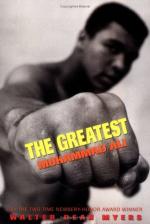
Pass he did. By 1970, when he fought Jerry Quarry in Atlanta, Ali was regaining public confidence and boxing dominance. The following year, the U.S. Supreme Court reversed his conviction. And in March 1971 in Manila, the Philippines, Ali fought champion Joe Frazier. The heavyweight bout was hyped as the "thrilla in Manila." Ali lost "the thrilla " in a 15-round decision. He later said it devastated him. Admitting that he hit Frazier with "punches that'd bring down the walls of a city," Ali declared the loss as feeling like death. No longer was he invincible. But he was down, not out. Fighting his way back, Ali beat Frazier in 1974 to become heavyweight champion once again. When he defeated George Foreman later that year, his title was secure. Ali defeated Frazier for the third time in 1975 and also published his autobiography, The Greatest: My Own Story.

Muhammad Ali defended his heavyweight title six times, finally losing to Leon Spinks in 1978 in a split decision. He won the title back from Spinks on a unanimous decision seven months later. With a record of only three losses in 59 fights, Ali announced his retirement in 1979. But he returned to the ring in 1980 and 1981, losing fights first to Larry Holmes and then to Trevor Berbick of Canada.

Many noticed with concern after the Holmes fight that Ali appeared sluggish and inarticulate. In 1984, the diagnosis was confirmed. After years of enduring repeated trauma to the head, Ali was suffering from what used to be characterized as "punch drunk." Sometimes called Pugilistic Parkinsonism, the illness is a result of neurological damage and exhibits Parkinsonian symptoms of slurred speech, poor balance, and facial immobility. A former doctor of Ali's reported that he urged the fighter to quit in 1977 when he noticed signs of neurological damage, but, as Ali later admitted, "Once you feel that recognition - the roar of 50,000 people, you just don't want to give it up." After he quit boxing for good, Ali continued to contribute to numerous charities and causes, especially those involving children. Although he rarely appeared in public, millions of his fans watched him light the Olympic torch to open the Summer Games in Atlanta, Georgia, in 1996.

Recent Updates

December 10, 2003: GOAT: A Tribute to Muhammad Ali was published by Taschen. Contributors to the book included Benedikt Taschen, Muhammad Ali, Jeff Koons, Howard L. Bingham, and Neil Leifer. Source: New York Times, www.nytimes.com, December 10, 2003.

May 4, 2004: Ali was honored by the Arab American Institute for his service to developing nations. Source: SI.com, http://sportsillustrated.cnn.com/2004/more/05/05/bc.box.arabaward.ali.ap/index.html, May 5, 2004.

This is the complete article, containing 954 words (approx. 3 pages at 300 words per page).

View More Summaries on Muhammad Ali
More Information
  • View Muhammad Ali Study Pack
  • 23 Alternative Definitions
  • Search Results for "Muhammad Ali"
  • Add This to Your Bibliography
  • More Products on This Subject
    Muhammad Ali
    Muhammad Ali (born Cassius Clay, 1942) was the only professional boxer to win the heavyweight champ... more

    Ali, Muhammad
    (born Jan. 17, 1942, Louisville, Ky., U.S.) American professional boxer and social activist. Ali wa... more


    Ask any question on Muhammad Ali and get it answered FAST!
    Answer questions in BookRags Q&A and earn points toward
    discounted or even FREE Study Guides and other BookRags products!
    Learn more about BookRags Q&A
    Copyrights
    Muhammad Ali from World of Criminal Justice. ©2005-2006 Thomson Gale, a part of the Thomson Corporation. All rights reserved.

    Join BookRagslearn moreJoin BookRags


    About BookRags | Customer Service | Report an Error | Terms of Use | Privacy Policy