
BookRags.com Literature Guides Literature
Guides
Criticism & Essays Criticism &
Essays
Questions & Answers Questions &
Answers
Lesson Plans Lesson
Plans
My Bibliography Periodic Table U.S. Presidents Shakespeare Sonnet Shake-Up
Research Anything:        
History | Encyclopedias | Films | News | Create a Bibliography | More... Login | Register | Help

Not What You Meant?  There are 7 definitions for Bad Seed.  Also try: The Buccaneer.

Maxwell Anderson Biography

Print-Friendly  Order the PDF version  Order the RTF version
About 2 pages (510 words)
Maxwell Anderson Summary

Bookmark and Share Know this topic well? Help others and get FREE products!
Name: Maxwell Anderson
Birth Date: December 15, 1888
Death Date: February 28, 1959
Place of Birth: Atlantic, Pennsylvania, United States
Place of Death: Stamford, Connecticut, United States
Nationality: American
Gender: Male
Occupations: playwright

Encyclopedia of World Biography on Maxwell Anderson

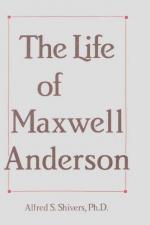
Maxwell Anderson (1888-1959), an American playwright noted for his verse dramas, tried to show men living by their beliefs even in a world where evil tends to dominate.

Maxwell Anderson was born in Atlantic, Pa., on Dec. 15, 1888. Since his father, William, was a Baptist clergyman who changed parsonages frequently, Anderson attended 13 schools in states from Pennsylvania to North Dakota. In 1911 he graduated from the University of North Dakota and married Margaret Haskett. He taught at Stanford University while earning his master's degree and held positions with the Call-Bulletin and the Chronicle in San Francisco. In New York from 1918 on, he contributed to the New Republic, worked on the Evening Globe and the World, and helped found a poetry magazine, The Measure.

The production of White Desert (1923) started Anderson's writing career on the New York stage. Of his eight plays produced prior to 1930, four were written in collaboration and one was an adaptation of a novel. His collaboration with Laurence Stallings on What Price Glory" (1924) was successful. A realistic portrait of men in war, it proved a welcome contrast to earlier romantic treatments of the subject. Saturday's Children (1927), a compassionate though conventional domestic drama, was received favorably. Anderson collaborated on an interesting failure concerned with the Sacco-Vanzetti case, Gods of the Lightning (1928), in which propaganda overcame dramatic skill.

Anderson's reputation soared in the 1930s. Elizabeth the Queen (1930) is a moving story of love confronted by the realities of politics and ambition. Mary of Scotland (1933) has a memorable picture of a woman overcome in a political battle to the death. Both Your Houses (1933), with its political intrigue in Congress, received the Pulitzer Prize. Anderson's wife had died in 1931, and he married Gertrude Maynard in 1933. Two years later he won his first Drama Critics' Circle Award with Winterset, a mature treatment of the Sacco-Vanzetti materials with a daring use of verse; he won this prize again with High Tor (1936), an effective blend of fantasy and reality. The Star Wagon (1937) and Knicker-bocker Holiday (1938) were popular successes. In 1938 he helped organize the Playwrights Company.

With the exception of Journey to Jerusalem (1940), the influence of the war appears in all his plays from Key Largo (1939) through Truckline Café (1946); the most esteemed is The Eve of St. Mark (1942). Columbia University recognized his accomplishments with an honorary doctor's degree in 1946. In the following year his Off Broadway: Essays about the Theatre was published.

After World War II Anderson's reputation faded. Of his last eight plays, Joan of Lorraine (1946) and Anne of a Thousand Days (1948) are notable, but only Lost in the Stars (1949), a musical adaptation of a novel on South Africa, was a critical success.

Following the death of his second wife in 1953, Anderson married Gilda Oakleaf. He continued to enjoy relative seclusion and a rural atmosphere while avoiding personal publicity and Broadway habitats. His thirty-second and last full-length play, The Golden Six (1958), was a failure. Anderson died in Stamford, Conn., on Feb. 28, 1959.

This is the complete article, containing 510 words (approx. 2 pages at 300 words per page).

View More Summaries on Maxwell Anderson
More Information
  • View Maxwell Anderson Study Pack
  • 7 Alternative Definitions
  • Search Results for "Maxwell Anderson"
  • Add This to Your Bibliography
  • More Products on This Subject
    Maxwell Anderson
    Maxwell Anderson was among the generation of playwrights who changed the world's perception of Amer... more

    Maxwell Anderson
    A teacher, journalist, and poet, Maxwell Anderson brought to the theater of the twentieth century a... more


    Ask any question on Maxwell Anderson and get it answered FAST!
    Answer questions in BookRags Q&A and earn points toward
    discounted or even FREE Study Guides and other BookRags products!
    Learn more about BookRags Q&A
    Copyrights
    Maxwell Anderson from Encyclopedia of World Biography. ©2005-2006 Thomson Gale, a part of the Thomson Corporation. All rights reserved.


    Join BookRagslearn moreJoin BookRags


    About BookRags | Customer Service | Report an Error | Terms of Use | Privacy Policy

