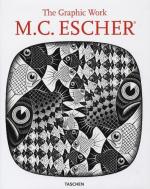
The Dutch artist Maurits Cornelis Escher was born on June the 17th, 1898 in Leeuwarden, the Netherlands. Trained as a graphic artist, Escher became well known for his drawings of scenes that seem to play visual logic against realistic impossibility.
Escher was the youngest of three sons born to George Arnold Escher and Sarah Gleichman Escher. As a youth, Escher was encouraged by his father, a civil engineer, to learn carpentry and other craft skills. He attended elementary and secondary school in Arnhem and in the seaside town of Zandvoort, a place that was selected for the benefit of his poor health. Failing his final exam, Escher never officially graduated from secondary school.
Nevertheless, in 1918, Escher began architectural studies at the Higher Technology School in Delft. Later he moved to Haarlem to study at the School for Architecture and Decorative Arts. But by 1919 Escher had discovered that his real interest lay in graphic arts rather than architecture.
For the next two years, therefore, Escher pursued studies in art school, gaining a mastery of graphics and wood cutting techniques. Following his graduation, he traveled in southern Europe in search of inspiration for his work.
In 1924, he held his first one-man art show in Holland. Later that year, he married Jetta Umiker in Viareggio, Italy. The late 1920s saw Escher living in Rome with his wife and child. In 1929, he held five shows in Holland and Switzerland. Some of Escher's most striking Italian landscapes date from this period.
Escher's early work tended to be realistic portrayals of the landscape and architecture that he saw during his travels. Visiting the Alhambra in Granada, he was intrigued by the Moorish designs that covered the walls. These designs had a profound influence on his work after 1937.
In the 1930s, Escher moved away from the true-to-life themes inspired by southern Italy, and began to look instead toward Switzerland, Belgium, and Holland for ideas.
With the invasion of Holland and Belgium by the Nazi army in 1940, Escher and wife relocated to Baarn, Holland. By the late 1940s, besides creating woodcuts, lithographs, and occasional mezzotints, Escher was involved in the design of a tapestry and even a ceiling decoration.
By the early 1950s, Escher had also achieved popularity as a lecturer, and was in demand as a speaker to groups of artists and scientists alike.
Beginning in 1956, Escher tried to find ways to express the notion of infinity within the bounds of a finite print. The objects in most of his works prior to 1958 appear to be shrinking toward the center of the print, but after that time, they give the appearance of shrinking toward the outer edges.
This change in Escher's focus reportedly came in response to his reading an article by the mathematician H. M. S. Coxeter of Ottawa that included an illustration of a system for reducing a plane-filling motif as the distance from the center of a circle increases. At least six of Escher's major works appear to be based on Coxeter's system.
In 1959, Escher met Professor Caroline MacGillavry. MacGillavry arranged for Escher present a lecture on symmetry to an international meeting of crystallographers in England in 1960. (The lecture was later repeated in Canada and the US.) In the same year, Escher received a copy of an article co-authored by Roger Penrose that described that mathematician's notion of impossible objects. Penrose's article referred to Escher's early works, and actually inspired others.
Escher's work with periodic repetitions had achieved considerable popularity in the late 1950s and 1960s, and in 1961 he authorized the International Union of Crystallography to publish a book about them. The book, Symmetry Aspects of M.C. Escher's Periodic Drawings, was published in 1965.
In Escher's most famous work, patterns are repeated in regularly divided planes to create impossible constructions, and the illusion of infinite space. His later work drew heavily on his intuitive understanding of mathematical concepts.
This is the complete article, containing 642 words
(approx. 2 pages at 300 words per page).
View More Summaries on M. C. Escher