Forgot your password?  

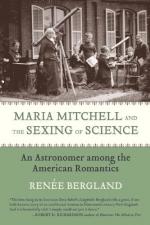
Maria Mitchell | Biography

This Biography consists of approximately 2 pages of information about the life of Maria Mitchell.
This section contains 584 words
(approx. 2 pages at 300 words per page)

World of Scientific Discovery on Maria Mitchell

Maria Mitchell came by her love of learning naturally. Since her mother worked in libraries, she became an avid reader; her father enjoyed astronomy immensely, providing Maria early exposure to that field. In addition, she grew up in Nantucket, where people knew and appreciated natural phenomena. Although she completed her formal schooling at age sixteen, Mitchell studied further on her own, reading French authors, books on mathematics, and Bodwitch's Practical Navigator.

At seventeen she opened her own school, the beginning of a lifelong interest in educating others. She was unconventional in her approach to teaching, sometimes starting the school day before dawn to allow students to see certain birds, or extending class time into the night to encourage astronomical observations.

In 1836 she became a librarian, a post which gave her time to make an unusual astronomical discovery. Since the library was only open afternoons and Saturday evenings, she spent a great deal of time studying and observing the sky. On October 1, 1847, Mitchell discovered a new comet. Although a year passed before she was credited with the finding because of other claims, she eventually received a gold medal from the king of Denmark. In 1848 she was elected the first woman of the American Academy of Arts and Sciences and became the subject of numerous magazine articles. She also became close friends with Joseph Henry, a physicist and director of the Smithsonian Institution.

In 1849 she became an analyst for the American Ephemeris and Nautical Almanac and began to work for the United States Coast survey, helping calculate time, latitude, and longitude more accurately. As the chaperone for the daughter of a wealthy Chicago businessman, Mitchell traveled to Europe, where she visited observatories and met such famous individuals as author Nathaniel Hawthorne (1804-1864), astronomers John Herschel (1738-1822) and Mary Somerville (1780-1872), and Alexander von Humboldt.

In 1865 Mitchell became professor of astronomy and director of the observatory at Vassar College, a newly founded women's college in New York. She became a leading advocate of women's rights, arguing that women were suited for mathematics and other sciences. As she had done during her early years as an educator, Mitchell ignored the usual lecture method of instruction, stressing small classes and individual attention.

She toured Europe again in 1873 and that same year helped found the Association for the Advancement of Women, a moderate feminist group. She taught at Vassar for twenty-three years, retiring in 1888. Although she was offered a permanent residence at the school's observatory, Mitchell returned to her family's home in Lynn, Massachusetts, where she died in 1889. Continuing her legacy, the Maria Mitchell Observatory in Nantucket, Massachusetts now maintains an active program of observation and education in astronomy.

In assessing her impact, it is fair to say she was more of an observer and teacher rather than a theoretical astronomer. As observer, she was especially interested in the sun, witnessing several total eclipses, and watching sunspots to try to understand their origin and mutations. She believed they were rotating, gaseous storms on the solar surface. She viewed Jupiter's clouds very much as modern scientists do: she felt they were not just atmospheric phenomenon, but were elements of the body itself. These clouds were seething upward and moving at different rates. As Mitchell did, astronomers today believe Jupiter is a planet without a solid interior. When she observed Saturn, she claimed the rings and the globe must be of different composition, again presaging modern thought. She also spent time observing and speculating about nebula and binary stars.

This section contains 584 words
(approx. 2 pages at 300 words per page)
Copyrights
Maria Mitchell from World of Scientific Discovery. ©2005-2006 Thomson Gale, a part of the Thomson Corporation. All rights reserved.
Follow Us on Facebook
Homework Help