 Print
Print Word
Word PDF
PDF|
This section contains 5,887 words (approx. 20 pages at 300 words per page) |

|
Authors and Artists for Young Adults on Margaret Mitchell
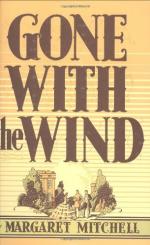
You do not have to have read Margaret Mitchell's Civil War epic Gone With the Wind (all 1,037 pages of it) to know of Rhett Butler and Scarlett O'Hara. You do not even have to have seen Gone With the Wind (all four hours of it) to be able to picture them, for in our collective mind, Clark Gable is the gentleman-rogue Rhett and Vivien Leigh is Scarlett, that unsinkable southern belle with an Irish fighting streak. And, without having seen either one, you might still be able to recite their most famous lines: "After all, tomorrow is another day"; and "My dear, I don't give a damn" (changed to "Frankly, my dear..." in the movie). Such is the cultural phenomenon of Gone With the Wind, grown out of an American book classic into something larger than itself, which a caricature in the New York Review captured cleverly: In...
|
This section contains 5,887 words (approx. 20 pages at 300 words per page) |
|