
 Print
Print Word
Word PDF
PDF|
This section contains 1,872 words (approx. 7 pages at 300 words per page) |

|
Encyclopedia of World Biography on M. C. Escher
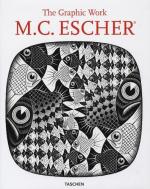
M.C. Escher (1898-1972) produced work that remains among the most widely reproduced and popular graphic art of the twentieth century. His brain-teasing prints use interlocking shapes, transforming creatures, and impossible architectures to challenge the viewer's perceptions of reality. Expressing what he called a "keen interest in the geometric laws contained by nature around us," his finely crafted compositions combine precise realism with fantastic explorations of pattern, perspective, and space.
Maurits Cornelis Escher (who called himself M.C.) was the youngest son of a hydraulic engineer but showed no early aptitude for mathematical concepts. He was such a poor student, in fact, that he twice had to repeat a grade. He did show some artistic talent and so was encouraged by an art teacher to pursue his interests in woodcuts and drawing. His father then sent him to the School for Architectural and Decorative Arts in Haarlem to...
|
This section contains 1,872 words (approx. 7 pages at 300 words per page) |
|



