
Forgot your password?  

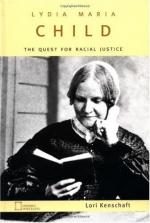
Lydia Maria Child | Biography

This Biography consists of approximately 2 pages of information about the life of Lydia Child.
This section contains 543 words
(approx. 2 pages at 300 words per page)

Dictionary of Literary Biography on Lydia Maria Child

Lydia Maria Child (11 February 1802-20 October 1880), abolitionist and popular author, was born into a large family at Medford, Massachusetts. At twelve her mother died and she was sent to live with her married sister in Maine. She remained there until 1824, when her brother Convers Francis was married, and she then joined his household at Watertown, Massachusetts. He took a personal hand in her education and introduced her into the circle of friends, including Emerson, that came to his house for discussions. She also met and formed lasting friendships with Theodore Parker and Margaret Fuller. In October 1826 she married David Lee Child, an active reformer who became a founding member of the New England Anti-Slavery Society. Soon after moving to the Boston area, Child found herself the mainstay of the family's finances as her husband remained an unemployed reformer with an occasional unsuccessful foray into agriculture. Starting with Hobomok, A Tale of Early Times in 1824, Child published five books by the time of her marriage and edited the Juvenile Miscellany from 1826. The Frugal Housewife, a compendium of household hints, was a great success in 1830 and was followed by The Mother's Book and The Girl's Own Book in the next year. Stirred to action by her husband's words, she joined the anti-slavery cause and in 1833 published An Appeal in Favor of That Class of Americans Called Africans. Some congratulated her for discussing the subject, but generally the public responded by boycotting her works. Other anti-slavery pieces and books dealing with the exploitation of the Indian also earned her more animosity than money. In May 1841 she agreed to move to New York as editor of the National Anti-Slavery Standard for the Anti-Slavery Society. When Child settled into her new role, she found herself opposed to William Lloyd Garrison's belief that the anti-slavery movement should not and could not work through normal governmental channels. Garrison's Liberator was abhorrent to her and she tried to avoid "inter-abolitionist controversy" by aiming the Standard at the uncommitted general public. The friction between her and Garrison's supporters in the Anti-Slavery Society proved too great and she resigned the Standard's editorship in May 1843. David, her associate on the paper, took over as editor and Child returned to writing and editing her own books. Her two series of Letters from New-York were financial successes and after David too resigned from the Standard in 1844, Child continued to support them by her writing. For the rest of her life she published widely on reform causes for herself and on domestic matters for her purse. The Childs moved to Massachusetts in 1850 and settled permanently at Wayland in 1852. In 1859 Child gained national attention for her concern over John Brown. After David's death in 1874, Child slowed down her writing pace and only contributed essays to books and journals. A prolific writer--she wrote nearly thirty books, edited a dozen more, edited journals, and authored numerous pamphlets--Child's work today is dated by its often cloying sentimentality. Yet she remains an important figure for her devotion to the anti-slavery cause, which dated from its beginning, and because she was one of the few female authors who made their living exclusively from their writing in mid-nineteenth-century America.

This section contains 543 words
(approx. 2 pages at 300 words per page)
Copyrights
Lydia Maria Child from Dictionary of Literary Biography. ©2005-2006 Thomson Gale, a part of the Thomson Corporation. All rights reserved.
Follow Us on Facebook
Homework Help

