
Forgot your password?  

Laurence Oliphant Biography

This Biography consists of approximately 4 pages of information about the life of Laurence Oliphant.
PDFPDF
Download:
Bookmark and Share
This section contains 1,058 words
(approx. 4 pages at 300 words per page)

Dictionary of Literary Biography on Laurence Oliphant

Laurence Oliphant's works are rarely read, although they are quite unlike other Victorian novels. His life, fascinating in its complexity and with a tragic gap between his promise and his achievements, has recently been the object of a sympathetic study, and he would seem to be worth investigating in order to show some of the more unusual and hidden sides of the Victorian character.

Oliphant was born in Capetown, South Africa, in 1829. His father and mother were both members of old Scottish families and both were fervent evangelicals in religion. In 1839 his father wa s made chief justice of Ceylon and knighted. Oliphant traveled widely in his youth, but his education was much interrupted. He did not go to a university but accompanied his parents on a prolonged tour of Europe, witnessing some of the revolutions of 1848. He joined the colonial bar in Ceylon and visited Nepal. He wrote an account of this trip which was published in 1852 while he was reading for the bar in England. His studies were interrupted by visits to Russia and by being appointed secretary to Lord Elgin, governor-general of Canada, who made Oliphant superintendent of Indian affairs. Returning to England in 1855, Oliphant then revisited Russia, about which he had written two books (published in 1853 and 1855), and was briefly at the siege of Sebastopol during the Crimean War before plunging further south into the Caucasus. In this campaign he had been acting as correspondent for the Times and in 1856 was invited by the editor of that newspaper to visit the southern United States. From here, after many adventures, he returned briefly to England before accompanying Lord Elgin, again as private secretary, on his visit to China. He wrote an account of the mission, Narrative of the Earl of Elgin's Mission to China and Japan, which was published in 1859. In 1860 he visited Italy and in 1861 Montenegro, before being appointed first secretary to the legation in Japan. Here he was badly wounded and returned home via Korea. The year 1862 was relatively quiet, with visits to Corfu, Italy, and Herzegovina; and in 1863 he made short expeditions to the rebellion in Poland, to Romania, and to the war in Schleswig-Holstein. Then, at the age of thirty-four, having visited every continent except South America and Australia and having had a fairly major hand in the affairs of more than a dozen countries, he was anxious to settle down.

In 1864 he started a journal entitled the Owl, contributing to the first ten numbers, and in 1865 wrote a short novel, Piccadilly (1870). This novel, highly praised by Michael Sadleir, has little plot but some amusing dialogue mildly reminiscent of Peacock. It tells of the efforts of Lord Frank Vane-court to woo and win Lady Ursula Newlyte in spite or because of the mercenary and hypocritical society around him. The world-weariness and the religious sincerity of Lord Frank are no doubt autobiographical. In the same year that he wrote Piccadilly, Oliphant was elected member of Parliament for the Stirling Burghs; but his meteoric career, which appeared to have reached its zenith, was about to take a peculiar, if not a tragic, turn. In Piccadilly he had praised, as the greatest poet of the age, Thomas Lake Harris, the leader of an obscure religious community in America. In 1867 he resigned his seat in Parliament and joined this community at Brocton, New York, near Lake Erie, making over his money to them. The next year Oliphant's mother joined the community but was not allowed much contact with her son. In 1870 Harris permitted Oliphant to return to Europe to act as Times correspondent in the Franco-Prussian War. While in Paris in 1871, he met Alice Le Strange and married her the next year; but there were difficulties when she, too, was forced to join Harris's community. In 1873 all three Oliphants returned to Brocton. While Oliphant was allowed to engage in commercial enterprises for the community, his wife and mother were given menial tasks, and for long periods he was kept away from them. Oliphant was involved in schemes to colonize Palestine for the Jews and visited Egypt. In 1881 Lady Oliphant died, and Oliphant began to be troubled by doubts about Harris, whom he had always called Father. Accompanied by his wife, he visited the Near East in 1882 and at Haifa wrote a second novel, Altiora Peto (1883), which is another statement of Oliphant's religious views. (The title means "I seek higher things.") As in Piccadilly, the heroine, oddly named Altiora, tries to find true religion in the middle of the frenzied folly of the smart social set. By this time the break with Harris was fairly severe, and in 1886 Oliphant published a hostile portrait of him in Masollam, which Sadleir calls an "enfeebled" novel. Alice Oliphant died in 1887, and Oliphant believed that she showed herself to him in spiritual manifestations. Autobiographical papers he had published in Blackwood's Magazine were collected in a volume appropriately entitled Episodes in a Life of Adventure; or, Moss from a Rolling Stone (1887), and he continued to write religious books and pamphlets. Oliphant married again in 1888, but shortly afterward he became ill and died on 23 December.

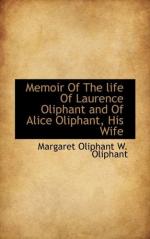
Few men can have done so much and achieved so little as Laurence Oliphant. Contemporary accounts and the publication in 1891 by Margaret Oliphant (a distant relative) of Memoir of the Life of Laurence Oliphant and of Alice Oliphant, His Wife, attest to the charm of his personality and the brilliance of his intellect. One's regret at his strange religious delusions is tempered by an awareness that even when under the influence of Harris he showed both energy and efficiency. His novels are hard to appreciate in an age when there is little interest in religious enthusiasm or life in high society, and the combination of the two seems almost impossible. Oliphant's clever assault on the Wholly Worldlies and the Worldly Holies is not understood by those who have never associated worldliness with holiness. The ephemeral nature of journalism is reflected in the novels, which have become badly dated; and somehow the novels, though full of spiritual fervor, lack the vigor which Oliphant showed in his life. Nevertheless, they are still worth reading as insights into an unusual and exciting Victorian character.

This section contains 1,058 words
(approx. 4 pages at 300 words per page)
Copyrights
Laurence Oliphant from Dictionary of Literary Biography. ©2005-2006 Thomson Gale, a part of the Thomson Corporation. All rights reserved.
Follow Us on Facebook
Homework Help