
BookRags.com Literature Guides Literature Guides Criticism/Essays Criticism/Essays Biographies Biographies My Bibliography Periodic Table U.S. Presidents Shakespeare Sonnet Shake-Up
Research Anything:        
History | Encyclopedias | Films | News | Create a Bibliography | More... Login | Register | Help
Not What You Meant?  There are 9 definitions for Langston.

Search "Langston Hughes"

Biographies Navigation
 

Langston Hughes Biography

Print-Friendly  Order the PDF version  Order the RTF version
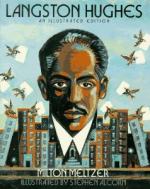
Milton Meltzer
About 3 pages (976 words)
Langston Hughes Summary

Bookmark and Share
Name: Langston Hughes
Birth Date: February 1, 1902
Death Date: May 22, 1967
Place of Birth: Joplin, Missouri, United States
Place of Death: New York, New York, United States
Nationality: American
Ethnicity: African American
Gender: Male
Occupations: poet, playwright

Encyclopedia of World Biography on Langston Hughes

American author Langston Hughes (1902-1967), a moving spirit in the artistic ferment of the 1920s often called the Harlem Renaissance, expressed the mind and spirit of most African Americans for nearly half a century.

Langston Hughes was born in Joplin, Mo., on Feb. 1, 1902. His parents soon separated, and Hughes was reared mainly by his mother, his maternal grandmother, and a childless couple named Reed. He attended public schools in Kansas and Illinois, graduating from high school in Cleveland, Ohio, in 1920. His high school companions, most of whom were white, remembered him as a handsome "Indian-looking" youth whom everyone liked and respected for his quiet, natural ways and his abilities. He won an athletic letter in track and held offices in the student council and the American Civic Association. In his senior year he was chosen class poet and yearbook editor.

Hughes spent the next year in Mexico with his father, who tried to discourage him from writing. But Hughes's poetry and prose were beginning to appear in the Brownie's Book, a publication for children edited by W. E. B. Du Bois, and he was starting work on more ambitious material dealing with adult realities. The poem "A Negro Speaks of River," which marked this development, appeared in the Crisis in 1921.

Hughes returned to America and enrolled at Columbia University; meanwhile, the Crisis printed several more of his poems. Finding the atmosphere at Columbia uncongenial, Hughes left after a year. He did odd jobs in New York. In 1923 he signed on as steward on a freighter. His first voyage took him down the west coast of Africa; his second took him to Spain. In 1924 he spent 6 months in Paris. He was relatively happy, produced some prose, and experimented with what he called "racial rhythms" in poetry. Most of this verse appeared in African American publications, but Vanity Fair, a magazine popular among middle and upper-class women, published three poems.

Later in 1924 Hughes went to live with his mother in Washington, D.C. He hoped to earn enough money to return to college, but work as a hotel busboy paid very little, and life in the nation's capital, where class distinctions among African Americans were quite rigid, made him unhappy. He wrote many poems. "The Weary Blues" won first prize in 1925 in a literary competition sponsored by Opportunity, a magazine published by the National Urban League. That summer one of his essays and another poem won prizes in the Crisis literary contest. Meanwhile, Hughes had come to the attention of Carl Van Vechten, a white novelist and critic, who arranged publication of Hughes's first volume of verse, The Weary Blues (1926).

This book projected Hughes's enduring themes, established his style, and suggested the wide range of his poetic talent. It showed him committed to racial themes--pride in blackness and in his African heritage, the tragic mulatto, the everyday life of African Americans--and democracy and patriotism. Hughes transformed the bitterness which such themes generated in many of his African American contemporaries into sharp irony, gentle satire, and humor. His casual-seeming, folklike style, reflecting the simplicity and the earthy sincerity of his people, was strengthened in his second book, Fine Clothes to the Jew (1927).

Hughes had resumed his education in 1925 and graduated from Lincoln University in 1929. Not without Laughter (1930) was his first novel. The story deals with an African American boy, Sandy, caught between two worlds and two attitudes. The boy's hardworking, respectability-seeking mother provides a counterpoint to his high-spirited, easy-laughing, footloose father. The mother is oriented to the middle-class values of the white world; the father believes that fun and laughter are the only virtues worth pursuing. Though the boy's character is blurred, Hughes's attention to details that reveal African American culture in America gives the novel strength.

The relative commercial success of his novel inspired Hughes to try making his living as an author. In 1931 he made the first of what became annual lecture tours. He took a trip to Soviet Union the next year. Meanwhile, he turned out poems, essays, book reviews, song lyrics, plays, and short stories. He edited five anthologies of African American writing and collaborated with Arna Bontemps on another and on a book for children. He wrote some 20 plays, including Mulatto, Simply Heavenly, and Tambourines to Glory. He translated Federico Garcia Lorca, the Spanish poet, and Gabriela Mistral, the Latin American Nobel laureate poet, and wrote two long autobiographical works.

As a newspaper columnist, Hughes created "Simple," probably his most enduring character, brought his style to perfection, and solidified his reputation as the "most eloquent spokesman" for African Americans. The Simple sketches, collected in five volumes, are presented as conversations between an uneducated, African American city dweller, Jesse B. Semple (Simple), and an educated but less sensitive African American acquaintance. The sketches, which ran in the Chicago Defender for 25 years, are too varied in subject, too relevant to the universal human condition, and too remarkable in their display of Hughes's best writing for any quick summary. That Simple is a universal man, even though his language, habits, and personality are the result of his particular experiences as an African American man, is a measure of Hughes's genius.

Hughes received numerous fellowships, awards, and honorary degrees, including the Anisfield-Wolf Award (1953) for a book on improving race relations. He taught creative writing at two universities; had his plays produced on four continents; and made recordings of African American history, music commentary, and his own poetry. He was elected to the American Academy of Arts and Sciences and to the National Institute of Arts and Letters. His work, some of which was translated into a dozen languages, earned him an international reputation unlike any other African American writer except Richard Wright and Ralph Ellison. Forty-seven volumes bear Hughes's name. He died in New York City on May 22, 1967.

This is the complete article, containing 976 words (approx. 3 pages at 300 words per page).

View More Summaries on Langston Hughes
More Information
  • View Langston Hughes Study Pack
  • 9 Alternative Definitions
  • Search Results for "Langston Hughes"
  • Add This to Your Bibliography
  • More Products on This Subject
    Langston Hughes
    As a household name for so many readers of varying persuasions, Langston Hughes was perhaps the mos... more

    Langston Hughes
    "I didn't know the upper class Negroes well enough to write much about them," Langston Hughes said ... more


    Copyrights
    Langston Hughes from Encyclopedia of World Biography. ©2005-2006 Thomson Gale, a part of the Thomson Corporation. All rights reserved.

    Join BookRagslearn moreJoin BookRags


    About BookRags | Customer Service | Report an Error | Terms of Use | Privacy Policy

