 Print
Print Word
Word PDF
PDF|
This section contains 281 words (approx. 1 page at 300 words per page) |
World of Sociology on Kingsley Davis
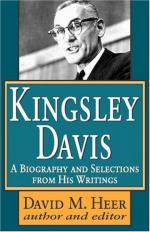
Davis coined the terms, zero population growth and population explosion. The lifelong interest of sociologist Kingsley Davis was the comparative study of population structure and change. Davis was born in Tuxedo, Texas, August 20, 1908, and educated at the University of Texas (A.B. 1930, M.A. 1932) and Harvard University (Ph.D. 1936). He taught at Smith College, Northampton, Massachusetts (1934-1936), Clark University, Worcester (1936-1937), Penn State University, University Park (1937-1942), and Princeton University (1942-1949). In 1945, he edited World Population in Transition, an important analytical tool, and in 1948, he published his first major work Human Society, a classic textbook that detailed his interest in the family structure. From this came an offer to teach in the Bureau of Applied Social Research, Columbia University, New York City (1949-1955). In 1955, Davis went to the University of California, Berkeley, and in 1977, he was named Distinguished Professor of Sociology, University of Southern California, Los Angeles. He died in Stanford, California, February 27, 1997.
Davis took the temperature of the American family for half a century. Overall, he held a generally gloomy view, feeling that marriage was weakened by the ease of contraception, divorce, and gender equality. "Interchangeable" marriage partners and voluntary marriage bonds caused a profound, permanent change in the marriage institution, Davis said, a change he felt was for the worse. He also saw the demise of industrial societies, which do not replace themselves in number or quality, whereas nonindustrial societies produce some 92 percent of the world's population.
Kingsley Davis gained prominence for his theories of demographic transition and zero population growth. In 1957, he predicted that the world population figure would climb to six billion by the year 2000. He was remarkably close; the target was reached in October 1999.
|
This section contains 281 words (approx. 1 page at 300 words per page) |