
BookRags.com Literature Guides Literature Guides Criticism/Essays Criticism/Essays Biographies Biographies My Bibliography Periodic Table U.S. Presidents Shakespeare Sonnet Shake-Up
Research Anything:        
History | Encyclopedias | Films | News | Create a Bibliography | More... Login | Register | Help

Search "Karl Raimund Popper, Sir"

Biographies Navigation
 

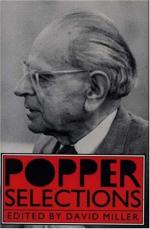
Karl Raimund Popper, Sir Biography

Print-Friendly  Order the PDF version  Order the RTF version
About 2 pages (528 words)
Karl Popper Summary

Bookmark and Share
Name: Karl R(aimund) Popper
Variant Name: Karl R. Popper, Karl Raimund Popper, Sir Karl Raimund Popper, Sir Karl R(aimund) Popper, Karl (Raimund) Popper, Karl Popper
Birth Date: July 28, 1902
Death Date: September 17, 1994
Nationality: British
Gender: Male

Encyclopedia of World Biography on Karl Raimund Popper, Sir

The Austrian philosopher Sir Karl Raimund Popper (1902-1994) offered an original analysis of scientific research that he also applied to research in history and philosophy.

Karl Popper was born in Vienna on July 28, 1902, the son of a barrister. He studied mathematics, physics, and philosophy at the University of Vienna. Though not a member of the Vienna Circle, he was in sympathy with some, if not all, of its aims. His first book, The Logic of Scientific Discovery (1935), was published in a series sponsored by the Circle. In 1937 Popper accepted a post in New Zealand as senior lecturer in philosophy at Canterbury University College in Christchurch.

At the end of World War II, Popper was invited to the London School of Economics as a reader, and in 1949 he was made professor of logic and scientific method. Popper then made numerous visits to the United States as visiting professor and guest lecturer. In 1950 he gave the William James Lectures at Harvard University. In 1965 Popper was knighted by Queen Elizabeth II.

Foundations of Popper's Theory

Popper's first book laid the foundations for all the rest of his work. It offered an analysis of the procedure to be used in scientific work and a criterion for the meaning of the statements produced in such work. According to Popper, the researcher should begin by proposing hypotheses. The collection of data is guided by a theoretical preconception concerning what is relevant or important. The examination of causal connections between phenomena is also guided by leading hypotheses. Such a hypothesis is scientific only if one can derive from it particular observation statements that, if falsified by the facts, would refute the hypothesis. A statement is meaningful, therefore, if and only if there is a way it can be falsified. Hence the researcher should strive to refute rather than to confirm his hypotheses. Refutation is real advancement because it clears the field of a likely hypothesis.

Understanding History and Society

Popper later applied his analysis of knowledge to theories of society and history. In The Open Society and Its Enemies (1945) he attacked Plato, G. W. F. Hegel, and Karl Marx as offering untenable totalitarian theories that are easily falsifiable. The Open Society is often considered one of Popper's most influential books of this century. It also was responsible for the prevalent use of the term "open society." Critics argue that Popper succeeded in this book and in its sequel, The Poverty of Historicism (1957), in formulating a deterministic theory about general laws of historical development and then refuting it. A lively controversy ensued on the issue of which philosophers, if any, held the doctrine Popper refuted. Popper found himself embroiled in a decade of polemics, particularly with partisans of Plato. Popper was thus credited with a convincing logical refutation but one misdirected in its targets.

Popper's later works Objective Knowledge (1972) and The Self and Its Brain (1977) combined his scientific theory with a theory of evolution. In the 1980s, Popper continued to lecture, focusing mainly on questions of evolution and the role of consciousness. Karl Popper died of complications from cancer, pneumonia, and kidney failure on September 17, 1994 at the age of 92.

This is the complete article, containing 528 words (approx. 2 pages at 300 words per page).

View More Summaries on Karl Popper
More Information
  • View Karl Raimund Popper, Sir Study Pack
  • Search Results for "Karl Raimund Popper, Sir"
  • Add This to Your Bibliography
  • More Products on This Subject
    Karl Raimund Popper, Sir
    The Austrian philosopher Sir Karl Raimund Popper (1902-1994) offered an original analysis of scient... more

    Karl R(aimund) Popper
    Karl Popper is regarded by many commentators as the greatest philosopher of the twentieth century. ... more


    Copyrights
    Karl Raimund Popper, Sir from Encyclopedia of World Biography. ©2005-2006 Thomson Gale, a part of the Thomson Corporation. All rights reserved.

    Join BookRagslearn moreJoin BookRags


    About BookRags | Customer Service | Report an Error | Terms of Use | Privacy Policy

