BookRags.com Literature Guides Literature
Guides
Criticism & Essays Criticism &
Essays
Questions & Answers Questions &
Answers
Lesson Plans Lesson
Plans
My Bibliography Periodic Table U.S. Presidents Shakespeare Sonnet Shake-Up
Research Anything:        
History | Encyclopedias | Films | News | Create a Bibliography | More... Login | Register | Help


John von Neumann Biography

Print-Friendly  Order the PDF version  Order the RTF version
About 3 pages (808 words)
John von Neumann Summary

Bookmark and Share Questions on this topic? Just ask!
Name: John Von Neumann
Variant Name: John von Neuman
Birth Date: December 28, 1903
Death Date: February 8, 1957
Place of Birth: Budapest, Hungary
Place of Death: Washington, DC, United States
Nationality: American
Gender: Male
Occupations: mathematician

World of Scientific Discovery on John von Neumann

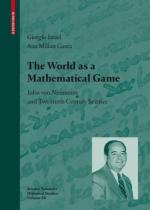
John von Neumann, who was born in Budapest, Hungary in 1903, was primarily a mathematician but made important contributions to an unusually great number of fields of inquiry, including computer science, quantum physics and economics.

Von Neumann was trained in Europe but emigrated to the United States in 1930 to join the faculty at Princeton University. Three years later he moved to the Institute of Advanced Studies at Princeton. During World War II, he became involved as a consultant with several government projects during the second world war, proving his ability not only as a scientist but as an administrator. Most notably, he acted as consultant in the development of the atomic bomb at the Los Alamos Scientific Laboratory and was a principal player in the development of high-speed digital computers and the stored programs used in virtually all contemporary computer applications.

Von Neumann was primarily interested in pure mathematics at the beginning of his career. His early work was chiefly in the fields of mathematical logic, set theory, and operator theory. However, he was equally able as an applied mathematician and published a book on quantum mechanics, The Mathematical Foundation of Quantum Mechanics in 1932, which still remains a standard treatment of the subject.

In 1944 Von Neumann published The Theory of Games and Economic Behavior (written with the economist Oskar Morgenstern) and brought about a revolution in the social sciences. Von Neumann and Morgenstern argued that the mathematics as developed for the physical sciences was inadequate for economics, which after all involves human action based on choice and also chance. Von Neumann proposed a different mathematical approach more suitable for the social sciences and provided an analysis of strategies, taking into account the interdependent choices of two or more "players." Game theory is based on an analogy between games and any complex decision-making process involving two or more players such as it can be found in economics, military science, politics or any other social process. Game theory assumes that all participants act rationally at all times to maximize the outcome of the "game" for themselves. It also assumes that all the participants are able to rank-order all possible outcomes without making mistakes. Von Neumann's analysis enables players to calculate the consequences or probable outcomes of any given choice. It then becomes possible to opt for those strategies that have the highest probability of leading to a positive outcome.

Game theory makes a number of distinctions between different kinds of game situations that will give some idea of the kinds of processes the theory deals with. Von Neumann proposed a fundamental distinction between zero-sum games, in which one player must lose what the other wins, and non-zero-sum games, in which a choice made by one player may result in improved outcomes for both parties. Another distinction concerns the difference between two-person games and n-person games. The analysis of n-person games is mostly concerned with the making of alliances and the effects of different strategies on the stability of the alliances. N-person games have an obvious application to politics. Finally, the theory distinguishes between cooperative games and non-cooperative games. Cooperative games are those situations where both cooperation and non-cooperation are rational choices that may result in positive outcomes for at least one of the players. Non-cooperative games, on the other hand, are those games in which players could only hurt themselves if they were to violate rules and agreements. Non-cooperation, then, would not be a rational choice and is simply ruled out.

Analyzing any economic, military or political situation in terms of the kind of game it is, and being able to calculate which choice will result in the most probable positive outcome obviously lays a foundation for making rational, well-informed choices. It is hardly surprising that the theory has been widely used in complex decision-making processes. However, many of the applications of game theory in the social sciences, and economics is a prime example, make the further assumption that human beings have always acted on the principles described in Von Neumann's theory, and that Von Neumann was only the first to describe these behavioral rules. It would then follow that game theory also supplies a good description of complex social processes, such as those studied by economics. To outsiders, however, it may be obvious that human beings sometimes behave recklessly, or act on hunches and gut feelings. The array of data to be processed for any rational decision may also be so complex that most human beings are simply not capable of grasping them. The theory cannot account for such human "failings," and as a model of social processes it is a little too tidy. Although game theory constitutes a brilliant use of mathematics and is properly applied in numerous situations, some of the applications it has received in the social sciences have stretched the theory further than it can properly go.

This is the complete article, containing 808 words (approx. 3 pages at 300 words per page).

View More Summaries on John von Neumann
More Information
  • View John von Neumann Study Pack
  • Search Results for "John von Neumann"
  • Add This to Your Bibliography
  • More Products on This Subject
    John Von Neumann
    The Hungarian-born American mathematician John Von Neumann (1903-1957) was the originator of the th... more

    John von Neumann
    John von Neumann, considered one of the most creative mathematicians of the 20th century, made impo... more


    Ask any question on John von Neumann and get it answered FAST!
    Answer questions in BookRags Q&A and earn points toward
    discounted or even FREE Study Guides and other BookRags products!
    Learn more about BookRags Q&A
    Copyrights
    John von Neumann from World of Scientific Discovery. ©2005-2006 Thomson Gale, a part of the Thomson Corporation. All rights reserved.

    Join BookRagslearn moreJoin BookRags


    About BookRags | Customer Service | Report an Error | Terms of Use | Privacy Policy