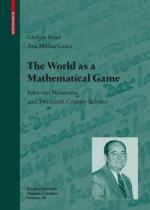
| Name: |
John Von Neumann |
| Variant Name: |
|
| Birth Date: |
|
| Death Date: |
|
| Place of Birth: |
|
| Place of Death: |
|
| Nationality: |
|
| Gender: |
|
| Occupations: |
|
John von Neumann, who was born in Budapest, Hungary, in 1903, was primarily a mathematician, and wrote numerous papers on both pure and applied math. He also made important contributions to a number of other fields of inquiry, including quantum physics, economics and computer science.
Von Neumann studied mathematics, physics and chemistry at German and Swiss universities for several years, finally receiving a Ph.D. in mathematics from the University of Budapest in 1926. He taught at Berlin and Hamburg from 1927 to 1930 and then emigrated to the United States to join the faculty at Princeton University. Three years later he took a position at the Institute of Advanced Studies at Princeton.
Until the outbreak of World War II, Von Neumann mostly did work in pure math, making important contributions to the fields of mathematical logic, set theory and operator theory. However, his work in operator theory had powerful applications in theoretical physics, and he published a book on quantum physics, The Mathematical Foundations of Quantum Mechanics in 1932. This work remains a standard text on the subject. During World War II, when the U.S. government called on a great many scientists to help out with the development of new technologies demanded by the war effort, Von Neumann took on numerous positions as a consultant. He was engaged in many different research projects and proved his ability as an administrator as well as a brilliant scientist. Among other consulting positions, he was involved with the development of the atomic bomb at the Los Alamos Scientific Laboratory. At about the same time, he caused a revolution in the social sciences with his work on game theory, Theory of Games and Economic Behavior, written with the economist Oskar Morgenstern and published in 1944. In those years, he also became a principal player in the development of high-speed digital computers and the stored programs used in virtually all contemporary computer applications.
While at Los Alamos, Von Neumann became impressed with the need to develop computational equipment technology that could carry out the enormously complex mathematical calculations which the scientists then had to carry out by hand. In 1944, Von Neumann became involved with efforts to develop computers, most notably ENIAC (Electronic Numerical Integrator and Calculator), which was then the most powerful device under construction. ENIAC could be programmed to do different tasks, but this required a partial rewiring of the machine. One of the scientists working on ENIAC, J. Presper Eckert, came up with the idea of a stored program, which would make it possible to load a computer program into computer memory from disk. The computer could then run the program without being manually reprogrammed. The idea was not used in the design of ENIAC, but a follow-up project, called EDVAC, which Von Neumann was closely associated with, did incorporate the stored program. A paper Von Neumann wrote in 1944, entitled "First Draft of a Report on EDVAC," explained the revolutionary ideas that were to govern the development of computers for the next two decades. Von Neumann proposed a separation of storage, arithmetic and control functions; random-access memory (RAM); stored programs; arithmetic modification of instructions; conditional branching; a choice between binary number and decimal number representation; and a choice between serial and parallel operation. Basically, he introduced new procedures in their logical organization, the "codes" by which a fixed system of wiring could solve a great variety of problems. Particularly the idea of a stored program and the solutions for realizing the equipment that could deal with stored programs were revolutionary, promising great gains in speed and productivity.
In summary, Von Neumann rethought the basic design of the computer into the separate components of arithmetic function, central control (now known as the central processing unit [CPU]), memory (the hard drive) and the input and output devices. Under Von Neumann's supervision, a computer with these capabilities was developed at the Institute of Advanced Studies from 1946 to 1951. Although the machine quickly became a dinosaur, it was the first true forerunner of the contemporary high-speed digital computer.
This is the complete article, containing 670 words
(approx. 2 pages at 300 words per page).
View More Summaries on John von Neumann