World of Scientific Discovery on John Burdon Sanderson Haldane
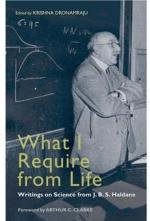
Haldane was born in Oxford, England, the son of well-known physiologist John Scott Haldane. As a boy, he participated in his father's experiments in human respiratory physiology, and as a student, he carried out breeding experiments on mice and guinea pigs. Haldane was educated at Eton and later attended New College, Oxford. Although he majored in mathematics, he excelled in classical studies and philosophy.
Haldane became an officer in the Black Watch regiment in France and the Middle East at the outset of World War I. After being wounded, he returned to study physiology at New College in 1919. He held a fellowship there until 1923, when he moved to Cambridge to work under English biochemist Frederick Gowland Hopkins for two years. After returning to London, Haldane accepted a position at University College as genetics chair and a part-time position at the John Innes Horticultural Institution at Merton. Haldane remained a Weldon professor of biometry at University College for twenty years. During much of this time, he was a member of the British Communist party and spoke on political issues. An outspoken Marxist during the 1930s, Haldane served temporarily as chairman of the editorial board of the London Daily Worker.
After serving in World War II, Haldane left the Communist party, disappointed with the fame accorded to Soviet biologist Trofim Denisovich Lysenko (1898-1976). In 1957, Haldane immigrated to India in objection to the Anglo-French invasion of Suez. There, he was appointed director of the Genetics and Biometry Laboratory in Orissa, which possessed exceptional research facilities. Haldane became a naturalized Indian citizen in 1961 and held positions at the Indian Statistical Institute in Calcutta. He remained in India until his death from cancer in 1964.
Haldane's eventful personal life is evident in his numerous advances in the field of genetics and evolutionary theory, which were augmented by his contributions to population genetics and population dynamics. Upon reading Gregor Mendel's work in 1901, Haldane began a mathematical analysis of genetics and evolution. He later informally indulged his interest in genetics by studying the laws of inheritance using his sister's three hundred guinea pigs.
Through mathematical analysis of mutation rates, Haldane became convinced that natural selection and not mutation was the driving force behind evolution. As a theoretical geneticist he formulated a mathematical theory of natural selection during the 1920s. This theory, combined with similar theories of two other geneticists, set the framework for the neo-Darwinian interpretation of evolution. This approach correlated classical genetics and evolutionary phenomena by incorporating mathematical analyses of mutation rates, intensities in selection, and rates of evolutionary change.
In 1932, Haldane estimated for the first time the mutation rate of a human gene and predicted the effect of recurring harmful mutations on a population. In 1936, he examined the link between hemophilia and color blindness. Haldane is also responsible for introducing the concept of genetic load, which is the percentage of deleterious or lethal genes present in a species population. After his introduction to enzyme reactions in 1924, Haldane produced the first proof that these reactions obey the laws of thermodynamics.
The interest in physiology Haldane had harbored since participating in his father's research led him to study the physiology of breathing, particularly with respect to deep-sea diving and safety in mines. During World War II, Haldane worked with his father again, this time to improve gas masks. Haldane wrote several books that are considered scientific classics, including Enzymes (1930) and The Causes of Evolution (1932).
This is the complete article, containing 571 words
(approx. 2 pages at 300 words per page).