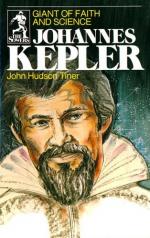
| Name: |
Johannes Kepler |
| Birth Date: |
|
| Death Date: |
|
| Place of Birth: |
|
| Place of Death: |
|
| Nationality: |
|
| Gender: |
|
| Occupations: |
|
Johannes Kepler, born in Weil in Würtemberg (now southwestern Germany) in 1571, seemed destined for a life in the church. He obtained a B.A. degree in theology in 1588 and entered the University of Tübingen, one of the great centers of Protestant learning, in 1589. He graduated with an M.A. in 1591.
While at Tübingen, Kepler had learned mathematics, and when the high school in Graz, Austria, needed a mathematics teacher, he got the job. He turned out to be very poor at teaching; during his first year only a handful of students attended his lectures, and the following year he had no students at all. That gave him considerable free time to further his interest in astronomy and produce annual almanacs, which were often heavy on astrological content. He also raised additional income by casting horoscopes.
Kepler, always the mystic, published a book in 1596 in which he devised a relationship involving the distances of the planets from the Sun with geometric solid objects such as cubes and spheres. His Mysterium Cosmographicum (Mystery of the Universe) showed considerable knowledge of astronomy and brought him to the attention of Tycho Brahe and Galileo.
Beginning in 1597, life for Protestants in the Catholic dominated area in which Kepler lived became unpleasant due to religious persecution, so Kepler moved to Prague (Czech Republic) in 1600, where he began working with the flamboyant Tycho Brahe.
Brahe was the antithesis of Kepler: Brahe had excellent eyesight that he used to compile the most detailed observational data in history; Kepler's eyesight was poor and he suffered from ill health all his life. Brahe was very well off financially, and his extravagance drove Kepler, who always seemed to be in reduced circumstances, to distraction. Their working relationship was not the best, but Brahe died within 18 months of Kepler's arrival.
Brahe had spent years making accurate observations of Mars with the naked eye and assigned Kepler the task of devising a theory of planetary motion using his observational data. Kepler, the mathematician, was superbly suited for this task, which would end up occupying the majority of his time for the next twenty years.
In 1604, before he had made much progress with Mars, a supernova blazed into view, and Kepler wrote two pamphlets about it. The supernova, like Brahe's Star in 1572, rivaled Venus in brightness and has since come to be known as Kepler's Star. He also wrote about applications of optics in astronomy and proposed a design for a telescope. After Galileo discovered the moons of Jupiter, Kepler used a telescope to prove to himself that they did, indeed, exist. He dubbed them satellites, a name that stuck.
The task with Mars was proving to be extremely difficult. The circular orbit Kepler calculated did not agree exactly with Brahe's observations. Kepler's creative imagination came up with theory after theory to account for the discrepancy; at one point, after three years of work, he had a geometrical scheme that disagreed with one observation by only 8 minutes of arc. (The full moon is 31 minutes of arc in diameter; two objects 4 minutes of arc apart are barely noticeable to a person with average eyesight.) But Kepler could not believe that Brahe's observations were anything less than perfect. He threw his scheme out and started again.
Kepler gave up on circles and epicycles and, out of desperation, tried working with an ellipse (oval). The results matched Brahe's data perfectly. Then he had to devise a law governing the variation of the speed of Mars as it moved along the ellipse. Here he got bogged down and lost his way, but he eventually formulated a simple law that matched observations. Finally, in 1609, Kepler published his first two laws of planetary motion. The first law states that a planet orbits the Sun in an ellipse, not a circle as Nicholas Copernicus had believed, while the second law states that a planet moves faster when near the Sun, and slower when farther away. Kepler thought, incorrectly, that magnetism in the Sun was responsible for the variation.
The third law was a long time in coming. In 1619 Kepler determined that the square of the time it takes a planet to orbit the Sun is equal to the cube of its average distance. In other words, once one knows how long it takes a planet to complete an orbit, one can calculate its relative distance from the Sun. However, one still has to have a definite measured distance for one planet to act as a yardstick to determine the distance of the others.
It seems likely that Kepler happened on this formula not by mathematical calculation, but by accident. He was constantly looking for mystical relations of numerical sequences to explain the "harmony of the heavens." In the same book in which the third law appears, Kepler devotes space to the "music of the spheres," assigning individual musical notes that each planet "sings."
Also in 1619, he published a book on comets in which he supported Brahe's contention that comets were celestial objects and not manifestations of the Earth's atmosphere. Kepler incorrectly believed them to be objects that moved in straight lines, but he had a remarkably accurate explanation of the Sun's part in producing a comet's tail.
Once again, religious persecution of Protestants caused Kepler to move, and he relocated to Ulm (Germany) in 1626. One year later he published his final great work: the Rudolphine Tables, a tabular collection of the motions of planets, dedicated to his former patron Emperor Rudolph II. They were used as the standard astronomical tables for the next century. Kepler died after a short illness on November 15, 1630, at the age of 59.
This is the complete article, containing 941 words
(approx. 3 pages at 300 words per page).
View More Summaries on Johannes Kepler