
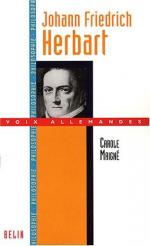
| Name: |
Johann Friedrich Herbart |
| Birth Date: |
|
| Death Date: |
|
| Place of Birth: |
|
| Place of Death: |
|
| Nationality: |
|
| Gender: |
|
| Occupations: |
|
Johann Friedrich Herbart (1776-1841) was a German philosopher, psychologist and educator, noted for his contributions in laying the foundations of scientific study of education.
Johann Friedrich Herbart was born on May 4, 1776, in Oldenburg, the son of the state councilor for Oldenburg. He attended the University of Jena (1794-1799). While there he studied under Johann Gottlieb Fichte and met Friedrich von Schiller. Upon graduation Herbart went to Interlaken, Switzerland, where he served as tutor to the governor's three sons. In Switzerland he met Johann Pestalozzi and visited his school at Burgdorf.
Herbart taught philosophy and pedagogy at Göttingen (1802-1809). He began to seek a sound philosophical base upon which to rest his educational theories. His major works during this time include ABC's of Observation (1804), The Moral or Ethical Revelation of the World: The Chief Aim of Education (1804), General Pedagogics (his chief educational work, 1806), Chief Points of Logic (1806), Chief Points of Metaphysics (1806), and General Practical Philosophy (1808).
In 1809 Herbart accepted the chair of philosophy at Königsberg University. He met Wilhelm von Humboldt, the Prussian commissioner of education, and at his request served on the commission for higher education. Herbart, a believer in normal schools and teacher education, sponsored the establishment of a pedagogical school and practice (laboratory) school at Königsberg in 1810. He then married Mary Drake, an English girl.
Herbart wrote System of Psychology (1814), Text-book of Psychology (1816), Psychology as a Science (1825), and a two-volume work, General Metaphysics (1829). His work cast him as a liberal thinker in many minds, and this did not fit well into the reactionary tone then gaining headway in Prussia. It cost him an appointment to Hegel's vacated chair of philosophy at Berlin University in 1831. Dissatisfied with the way things were progressing in Prussia, Herbart returned to Göttingen in 1833. He lectured at the university and published Outline of Pedagogical Lectures (1835). He died on Aug. 11, 1841.
Philosophy of Education
Herbart's influence on educational theory is very important, even at the present time. He not only developed a philosophical-psychological rationale for teaching but a teaching method as well. Herbart believed that the mind was the sum total of all ideas which entered into one's conscious life. He emphasized the importance of both the physical and the human environment in the development of the mind. To Herbart, ideas were central to the process. He felt they grouped themselves into what he called "apperceptive masses." By assimilation (or apperception) new ideas could enter the mind through association with similar ideas already present. This was the learning process.
Herbart's method of instruction has been identified by his students as involving the "Five Formal Steps of the Recitation." These are preparation, presentation, association, generalization, and application. Herbart went further to emphasize that through the proper correlation of subjects (curriculum materials) the student would come to understand the total unity of what is the world.
In Germany, Leipzig and Jena became centers for Herbartianism. It was through the influence of Americans who studied at Jena that the ideas of Herbart reached the United States (ca. 1890). The advocates formed the National Herbartian Society in 1892 (now the National Society for the Study of Education). Its purpose was to promote Herbart's ideas as they might relate to America's needs. The principal criticism which has been leveled at the Herbartians is the extreme formality into which they let Herbart's instructional method fall.
This is the complete article, containing 563 words
(approx. 2 pages at 300 words per page).
View More Summaries on Johann Friedrich Herbart

