
 Print
Print Word
Word PDF
PDF|
This section contains 7,927 words (approx. 27 pages at 300 words per page) |

|
Dictionary of Literary Biography on James T(homas) Farrell
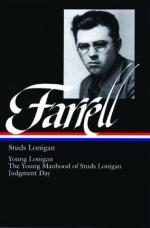
James T. Farrell, a major novelist of the 1930s, was a self-reliant literary intellectual who adhered to a credo that many critics judged old-fashioned in the post-World War II era. Proud to identify himself with the tradition of Theodore Dreiser, Sherwood Anderson, John Dos Passos, and others whom he believed "have written their best, scorning the commercial formula," he declared the unifying principle of his forty-one books of fiction to be the fervent belief that writers must remain true to their own feelings and experiences. The critic Chester E. Eisinger concluded that Farrell's refusal to abandon naturalist techniques for new literary trends in the 1940s stamped him as a "survivor," one who "clearly belonged to an earlier time." Another critic, John Aldridge, dismissed him in the early 1950s as a "Sherwood Anderson grotesque," unable to transcend the achievement of his Studs Lonigan trilogy (1935).
When Farrell died in 1979, the...
|
This section contains 7,927 words (approx. 27 pages at 300 words per page) |
|



