
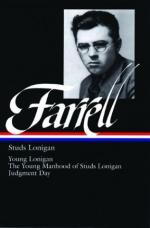
Dictionary of Literary Biography on James T(homas) Farrell
James Thomas Farrell, American novelist and short-story writer, was born on Chicago's South Side, the son and grandson of Irish-Catholic laborers. The young Farrell attended neighborhood parochial schools, and after graduating from high school he worked almost two years as an express company clerk. In 1925 he began four years of intense study and wide reading at the University of Chicago, taking time out during several months in 1927-1928 while he unsuccessfully tried to make his way as a writer in New York City. The following year he published his first short story, and by the end of the decade he had amassed manuscripts of many other tales and most of the first two Studs Lonigan novels. A half century later, the huge body of Farrell's realistic fiction numbered forty-two volumes.
In April 1931 with $65 between them, Farrell and his bride Dorothy Butler arrived in Paris to begin a year's residence. To the young couple, who lived in a succession of inexpensive lodgings in Sceaux-Robinson and on the Left Bank, it was to be a year of poverty and personal tragedy but also one of signal literary success and happiness. Ineligible for a work permit, Farrell managed to earn some $700 during the year by writing, a sum supplemented at irregular intervals by gifts and loans from family and friends. His story "Soap" portrays the financial hardships he and his wife endured in Paris. In December they sustained the death of their five-day-old son, and the year was further saddened for Farrell by the deaths of Julia Daly, the grandmother in whose home he had been brought up, and Paul Caron, a close Chicago friend of the twenties. "In Paris," Farrell has written, "my youth really ended." There too he first distinctly emerged as an important writer of realistic fiction.
Samuel Putnam, then living in Fontenay-aux-Roses, a suburb of Paris, was the earliest effective champion of that fiction. Late in 1930 Putnam was responsible for publishing "Studs" in This Quarter, going behind the back of the magazine's editor, Edward Titus. One year later he accepted Farrell's "Jewboy" for his own magazine, the New Review, and assigned its author two book reviews. His enthusiasm about Farrell spilled over in a letter directed to Ezra Pound in Rapallo and accompanied by a batch of Farrell's stories. Pound's response was immediate and decisive: the stories should be published; a new writer had arrived, he asserted, who answered several questions raised by the fiction of Henry James. Farrell and Pound met in May 1931 in a Paris restaurant, and Pound tried to find a publisher for a small book of four Chicago tales that he particularly liked: "The Scarecrow," "Looking 'Em Over," "Meet the Girls," and "Honey, We'll Be Brave." However, Desmond Harmsworth, the interested English publisher, and Jacob Schwartz of London, a few months later, both felt that Farrell's material was ill-suited for an English audience.
Nevertheless, Farrell did succeed in placing some stories while in Paris. Whit Burnett took "A Casual Incident" and "Spring Evening" for Story; Edward Titus purchased "The Merry Clouters" for This Quarter; and--as Farrell learned upon his return to New York City--H. L. Mencken selected "Helen, I Love You!" for the American Mercury . Peter Neagoe, who became a good friend of the Farrells in Paris, accepted "Soap" for his anthology Americans Abroad (1932). Bob Brown, writing urgently from Cagnes-sur-Mer, drew heavily on Farrell for his Readies for Bob Brown's Machine (1931), a collection which includes Farrell's "Jeff" and "Sylvester McGullick" as well as two Farrell collaborations. (Farrell "readified" "One of the Many" by his brother John A. Farrell and "adapted" Lloyd Stern's story "Percentage.")
In June 1931 James Henle of the Vanguard Press accepted Farrell's first novel, Young Lonigan (1932), and thereby initiated a long and fruitful association between author and publisher. At Henle's suggestion, Farrell added a new first chapter to Young Lonigan in order to introduce more effectively the central character Studs, and he deleted the gang-shag scene with Iris (published in 1957 as "Boys and Girls"), which was deemed vulnerable to censorship litigation. Henle's complete confidence in Farrell's talent was tangibly demonstrated during the Paris year by three advances on his work. This confidence and support were crucially important in Farrell's career, for Young Lonigan launched Farrell's most famous work: Studs Lonigan: A Trilogy (1935), which also includes The Young Manhood of Studs Lonigan (1934) and Judgment Day (1935). This massive work carefully chronicles the relentless drift of the title character Studs toward a premature death. Through the lens of Studs's consciousness, Farrell pictures an urban milieu densely populated with well-defined characters, many of whom, like the weak-willed Studs, are victimized by the illusions and spiritual poverty of their culture. The trilogy is a powerful and unified realistic narrative tragic in its emotional force and trenchant in its implicit social criticism.
With the manuscript of Young Lonigan in hand, Henle quickly contracted for Farrell's second novel, the as yet unwritten Gas-House McGinty (1933). Thus encouraged, Farrell put in long days and nights to produce the first draft of Gas-House McGinty in three weeks. Like Young Lonigan, this novel looks back to the author's Chicago past. It employs a richly idiomatic language to dramatize the effect of occupation--here a mindless commercial routine--upon the lives of Ambrose McGinty and his coworkers in the wagon call department of the express company. The company office, hectic in its rhythms and raucous in atmosphere, emerges as a central presence dominating the consciousness of all the characters. Their frustrations, passions, and sheer survival tactics in a corporate world are exposed with clarity and understanding. Farrell's intense imaginative involvement with the express company material kept him writing at his desk long after Gas-House McGinty was complete. From the manuscript that piled up came many tales published later, including "Omar James," "A Jazz-Age Clerk," "Lunch Hour: 1923," "Memento Mori," "Heinie Mueller," and the Willie Collins stories.
The impact made by Paris upon Farrell's mind and art derives in part from his wide reading at the time--in Trotsky, Proust, Upton Sinclair, William Faulkner, Thomas Wolfe, Lewis Carroll, James Joyce, D.H. Lawrence, Dashiell Hammett, Henry James, Spinoza, and Djuna Barnes, among others. It is suggested by the extraordinary number of friends and acquaintances he made there: Kay Boyle, Adam Fischer, Pierre Jean Robert (who translated Young Lonigan for the French edition), Christine Stead, Kathleen Coyle, Henri Poulaille, Emma Goldman, Robert McAlmon, Nancy Cunard, George Seldes, Nathan Klein, Eve Adams, Kenneth Knobloch, Meyer J. Handler, Ramon Fernandez, Lawrence Drake, and A. Lincoln Gillespie, to name only some. The Paris he knew in 1931-1932 is reflected in thirteen published stories ("Sorel," "An American Student in Paris," "Edna's Husband," "Guillotine Party," "Soap," "Mendel and His Wife," "After the Sun Has Risen,"After the Sun Has Risen," "Counting the Waves," "The Girls at the Sphinx," "Love Affair in Paris," "Fritz," "Paris Scene 1931," and "Scrambled Eggs and Toast") and in an unfinished manuscript of novel length. Farrell's Paris stories also include nine other tales drawing on his later experiences of that city, which he regularly revisits. Taken together, they form an important "panel" in the huge work he mapped out early in his career, one that now includes the Studs Lonigan, Danny O'Neill, and Bernard Carr series of novels, many volumes of short stories, and the ongoing cycle "A Universe of Time."
Assisted by Traveller's Aid, the Farrells, broke but resolute, returned to a Depression-ridden New York City in April 1932. Of his return Farrell has written: "I was not lacking in confidence. When I had come to Paris, I thought that I knew what I was doing, and after about a year, I was returning, with more, not less, confidence.... A good and productive year had ended. A sad year had ended. And I could no longer consider myself a youth."
After 1932 Farrell lived and worked in New York. There in the mid-thirties he became a leader in the anti-Stalinist literary-cultural Left in America. In particular he spoke out for integrity in criticism and for the artist's right to freedom of thought and expression from all forms of oppression. Still respected as a social and literary critic, he exerted an even stronger influence through his fiction--upon younger writers and the public at large. He remained a leading practitioner of twentieth-century critical Realism. Among his strengths are his sympathetic understanding of ordinary Americans, particularly Irish-Americans; his ability to create convincing major characters and entire communities of lesser characters deeply rooted in their urban environments; his architectural skill in building massive fictional structures; and the enduring soundness of the humanistic values dramatized in his fiction.
This is the complete article, containing 1,429 words
(approx. 5 pages at 300 words per page).

