 Print
Print Word
Word PDF
PDF|
This section contains 6,394 words (approx. 22 pages at 300 words per page) |

|
Authors and Artists for Young Adults on James Joyce
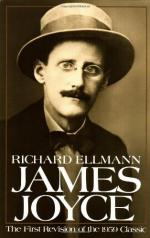
James Joyce is a monument of modernism in literature. In the opening passage of his biography, James Joyce, Richard Ellmann aptly summarized the writer's impact on twentieth-century letters, "We are still learning to be James Joyce's contemporaries, to understand our interpreter." Since the publication of Finnegans Wake, a critical commonplace has held that no author now writing in English can attempt to create a work of prose fiction without contending with the force of Joyce's reconstitution of the genre; but, as Ellmann's statement implies, such a presumption projects only a small measure of Joyce's intellectual and artistic achievement.
Contemporary readers can hardly take up a work of fiction without falling under the influence of the conventions that Joyce established for experiencing a text. Many feel his influence directly; editors regularly anthologize short stories from his 1914 Dubliners collection, and Joyce's first published novel, A Portrait of the Artist as...
|
This section contains 6,394 words (approx. 22 pages at 300 words per page) |
|