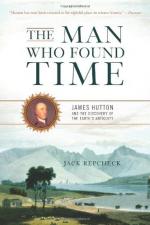
|
This section contains 651 words (approx. 3 pages at 300 words per page) |

World of Scientific Discovery on James Hutton
Hutton, considered to be the father of modern geology, was born in Edinburgh, Scotland, into a family of merchants. Hutton's father died when he was three years old. However, he provided generously for his children in his will, and Hutton never had to seriously pursue a living. As a young man Hutton entered Edinburgh University as a student of the humanities. He developed a strong interest in chemistry but accepted a law apprenticeship on the advice of friends who felt he should pursue a more lucrative career. Not long after he left his position to study medicine, then the only means of obtaining an extensive knowledge of chemistry. After moving briefly to Paris, he eventually transferred to the University of Leiden in Holland where he graduated in 1749 with his M.D. It was during this time that he developed an interest in geology and mineralogy.
After returning to Scotland, Hutton formed a partnership with a friend to manufacture ammonium chloride from soot, a process they had jointly discovered. As his business thrived, Hutton returned to the countryside near Edinburgh to take up farming on land inherited from his father. He remained there for the next fourteen years, attempting to apply scientific measures to traditional agricultural practices. While attempting to further his knowledge of agriculture, Hutton took a number of regional journeys, during which he became intrigued with Great Britain's many soils and rock types.
In 1768 Hutton leased his farm and moved to Edinburgh where he would spend the rest of his life. He became an active supporter of the Royal Society of Edinburgh and was accepted by the city's intellectual circle, which included James Watt, the inventor of the steam engine, and Joseph Black. By this time Hutton had begun to devote himself to geology; a visitor to his apartment once said that his study was so full of fossils that there was hardly any room to sit down.
In 1784 Hutton published his two-volume Theory of the Earth, the culmination of his careful studies and now considered one of the founding texts of modern geology. In it Hutton rejected the widely held belief that the Earth was no more than 6,000 years old, a figure arrived at by Biblical scholars. Instead he argued that the planet was significantly older and that its surface had undergone, and continued to undergo, a constant evolution. The forces of this change, he concluded, were several. Rivers carried silt to lakes and oceans where they were laid down and compressed into rock, while wind and rain wore down exposed surfaces. However, according to Hutton, the major cause of geologic change was volcanic activity. He viewed the planet's inner core as a "heat-engine" capable of fusing together sedimentary rock, causing upheavals in strata, and creating mountains. Hutton's vulcanist or plutonist theories contradicted those of the popular neptunists who postulated that the sediment from a vast ocean, perhaps resulting from the Great Biblical Flood, was responsible for all the various types of rock exposed at the surface.
Hutton's theory of constant change, later known as uniformitarianism, was not immediately accepted by the scientific community, who found his complicated Theory of the Earth difficult to understand. Most continued to adhere to neptunian views and those of the catastrophists who believed that change occurred as a result of periodic global catastrophes, not by continuous forces. Hutton, whose health had begun to fail during the writing of his book, died a few years after its publication. In 1802, however, Hutton's views gained popular attention after his friend John Playfair published Illustrations of the Huttonian Theory, which summarized and edited the geologist's work. This volume, along with the efforts of Charles Lyell in the 1830s, eventually led to the widespread acceptance of Hutton 's work and especially his concept of uniformitarianism. Today, geologists recognize the significance of Hutton's work, but believe that range of application for uniformitarianism is somewhat more limited than once thought.
|
This section contains 651 words (approx. 3 pages at 300 words per page) |