
BookRags.com Literature Guides Literature
Guides
Criticism & Essays Criticism &
Essays
Questions & Answers Questions &
Answers
Lesson Plans Lesson
Plans
My Bibliography Periodic Table U.S. Presidents Shakespeare Sonnet Shake-Up
Research Anything:        
History | Encyclopedias | Films | News | Create a Bibliography | More... Login | Register | Help

Not What You Meant?  There are 33 definitions for Harrington.

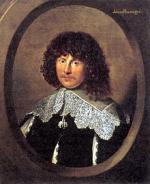
James Harrington Biography

Print-Friendly  Order the PDF version  Order the RTF version
About 2 pages (677 words)
James Harrington Summary

Bookmark and Share
Name: James Harrington
Birth Date: 1611
Death Date: September 11, 1677
Nationality: English
Gender: Male
Occupations: theorist, author

Encyclopedia of World Biography on James Harrington

The English political theorist James Harrington (1611-1677) is best known for "The Commonwealth of Oceana," a utopian treatise which advocates the establishment of an aristocratic republic.

The eldest son of Sir Sapcotes Harrington, James Harrington was born into an old and extremely well-connected family. After showing much academic promise as a child, he entered Trinity College, Oxford. Upon the death of his father, he left Oxford without taking a degree and began a tour of the Continent.

Harrington became a frequent visitor at The Hague and, after meeting the Prince of Orange, was introduced to the Elector and Electress Palatine. He accompanied the elector on at least one state visit to Denmark. His discretion so impressed the elector that Harrington was later commissioned to look after his affairs at the court of his brother-in-law, Charles I. Before returning to England, Harrington passed from Holland, through France, into Italy. Venice greatly interested him, and he proved a keen observer of the Venetian republican government, as his later works demonstrated.

Upon returning to England, Harrington sought to retire from court life and devote his time to study, but in 1638-1639 was co-opted by Charles as a member of his privy chamber. He then accompanied the King in the First Bishops' War against the Scots, but this appears to have been the extent of his active involvement in the events precipitated by that unsuccessful campaign. He does not seem to have taken part in the Short or Long Parliament, nor does he seem to have played a role in the Second Bishops' War or in the civil wars which ensued.

After Charles's defeat Harrington was named as one of the King's attendants. Although he was not in sympathy with the excesses of monarchy, he apparently got along very well with the King and is reported to have been with Charles at the time of his execution in 1649.

Harrington then turned his attention to the problem of choosing the best of all possible governments for England and began work on The Commonwealth of Oceana. He proposed a society in which all men of property would have a share; property was to be balanced by laws which limited the extent of individual wealth. A senate (drawn from historical examples) was to be elected by all men of property and was to propose laws. Once the laws had been ratified by the people, they were to be executed by an elected magistracy. All officials were to serve for limited terms to ensure the maximum participation on the part of the citizens of the Commonwealth. A community of interest served to hold the society together. Harrington's work reflected conditions in England, but in a sense the reflection was all too clear. "Olphaus Megaletor" was so obviously Oliver Cromwell that the government seized his manuscript. Only with the greatest difficulty did Harrington succeed in convincing Cromwell of his good intentions, but his work was restored to him and finally published in 1656.

Once in print, the work was violently attacked by monarchists and extreme republicans alike. These attacks led Harrington to pen a defense called The Prerogative of Popular Government, to abridge his work for a wider audience under the title The Art of Law Giving, and to further develop his views in a series of essays which were printed in 1659, the last year of the Commonwealth.

With the Restoration, Harrington retired from public life but at the end of 1661 was arrested as a traitor and thrown into the Tower. There appears to have been no basis for the accusations made against him, but Charles II's ministers evidently felt that his writings made him a dangerous foe of monarchical government. Transferred to a jail in Plymouth, he suffered from disease and from mistreatment at the hands of a prison physician, and he ultimately became insane. His release soon followed, but Harrington never recovered the full use of his faculties, nor did his health improve significantly. A late (and unhappy) marriage was followed by the onset of the gout and palsy; he died of a stroke on Sept. 11, 1677.

This is the complete article, containing 677 words (approx. 2 pages at 300 words per page).

View More Summaries on James Harrington
More Information
  • View James Harrington Study Pack
  • 33 Alternative Definitions
  • Search Results for "James Harrington"
  • Add This to Your Bibliography
  • More Products on This Subject
    Harrington, James (1611–1677)
    Harrington, James(1611–1677) The English political philosopher and publicist James Harringto... more

    James Harrington
    Every man, either to his terror or consolation, has some sense of religion.... more


    Copyrights
    James Harrington from Encyclopedia of World Biography. ©2005-2006 Thomson Gale, a part of the Thomson Corporation. All rights reserved.

    Join BookRagslearn moreJoin BookRags


    About BookRags | Customer Service | Report an Error | Terms of Use | Privacy Policy

