BookRags.com Literature Guides Literature Guides Criticism/Essays Criticism/Essays Biographies Biographies My Bibliography Periodic Table U.S. Presidents Shakespeare Sonnet Shake-Up
Research Anything:        
History | Encyclopedias | Films | News | Create a Bibliography | More... Login | Register | Help

Search "Jack Ruby"

Biographies Navigation
 

Jack Ruby Biography

Print-Friendly  Order the PDF version  Order the RTF version
About 3 pages (961 words)
Jack Ruby Summary

Bookmark and Share
Name: Jack Ruby
Variant Name: Jack Rubenstei
Birth Date: March 25, 1911
Death Date: January 3, 1967
Place of Birth: Chicago, Illinois, United States
Nationality: American
Gender: Male
Occupations: assassin, business owner

World of Criminal Justice on Jack Ruby

Jack Ruby was an unknown nightclub owner who became instantly famous in November 1963 as the man who shot and killed Lee Harvey Oswald two days after Oswald was arrested for assassinating President John F. Kennedy in Dallas, Texas. The apparent ease with which Ruby entered the Dallas police department garage and then shot Oswald helped fuel speculation about a conspiracy to kill Kennedy. In this scenario, Ruby was allowed to silence Oswald to prevent him from disclosing any incriminating information. Though no proof has ever been produced, Ruby's ties to organized crime gave conspiracy theorists a basis for their claims.

Born Jack Rubenstein on March 25, 1911 in Chicago, Illinois, Ruby dropped out of elementary school and led an unremarkable life. In his twenties he moved to California, where he worked as a singing waiter, a newspaper salesman and other odd jobs in Los Angeles and San Francisco. He returned to Chicago in 1937 and began scalping tickets and fencing stolen merchandise. A failed business and a brief try as boxer also led to nothing. Only World War II gave him an opportunity to enter a stable environment. He was drafted into the Army Air Force and served honorably. After being discharged in 1946, Ruby was again back on the streets with no prospects. However, in 1947 his sister persuaded him to move to Dallas to manage the Singapore Supper Club, which she ran as a nightclub. That same year he legally changed his name to Jack Ruby.

Between 1947 and 1963, Ruby owned parts of six different Dallas nightclubs. He lost money on all of them except the last one, a strip club called the Carousel. Despite this modest success, Ruby had a mental breakdown in 1952 and briefly considered moving back to Chicago. Throughout the 1950s Ruby tried other business ventures but remained mired in debt.

Many friends of Ruby characterized him as an insecure loser who desperately wanted to be noticed and liked. However, he also had a violent and explosive temper that he used to terrorize employees and to intimidate customers. Nevertheless, he was fascinated with police work and encouraged Dallas police officers to visit his clubs, giving them reduced rates and free drinks. Over the years he became friends of dozens of cops and became known within the department. To complicate matters, Ruby also was fascinated by organized crime. He enjoyed the visits by Mafia members to his club but they never trusted him. There is no evidence that Ruby was part of an organized crime family.

Ruby emerged from his personal oblivion two days after the November 22, 1963, assassination of President Kennedy. During the hours leading up to his final visit to the Dallas police headquarters, Ruby's mental state became precarious. Alternating between anger and anguish, Ruby was let into the headquarters on November 23 and was near the room where officers were interrogating Oswald. As Oswald left the room, Ruby was a few feet from him but did nothing. Ruby returned the next morning, just as the police were about to move Oswald to the county jail. The garage door to the station was open and Ruby walked in. Television cameras and reporters covered the transfer of Oswald, which was broadcast live. As Oswald was brought into the garage with an escort of police, Ruby walked in front of the cameras, pulled a gun and fatally shot Oswald.

Ruby's first attorney prepared a manslaughter defense, which was premised on Ruby's mental instability and lack of premeditation. This conservative defense would have sent Ruby to prison but for only a few years. However, the family discharged the lawyer and hired Melvin Belli, a San Francisco attorney who had a national reputation as civil tort attorney and as a relentless self-promoter. Belli proposed the affirmative defense of insanity. He based his claim on a supposed epileptic seizure that Ruby had suffered just before the shooting. Though a successful insanity defense produces an acquittal, juries are reluctant to give such a verdict absent overwhelming evidence. Medical experts discredited these claims and the police produced statements by Ruby that indicated premeditation. Ruby was convicted of first-degree murder and sentenced to death. However, the Texas Court of Criminal Appeals overturned his conviction in 1966 on procedural grounds. Ruby never received a second trial, as he died on January 3, 1967.

Ruby's act stunned the nation and erased the possibility of learning more about Oswald. President Lyndon Johnson appointed the Warren Commission to lead an investigation into the assassination. It was hoped that the conclusions of the commission would put to rest a growing number of conspiracy theories. Though the commission interviewed hundreds of witnesses and examined thousands of documents, its conclusion that Oswald was a lone assassin started rather than ended an ongoing controversy. The commission found no evidence that Ruby had any connection to a conspiracy.

A 1979 congressional committee report on the assassination concluded that there had been a conspiracy and that Ruby may have been tied to it through his organized crime connections. However, the committee could not produce any compelling evidence for its conclusions. Director Oliver Stone's popular 1991 movie, JFK, renewed the charge that a vast government-inspired conspiracy orchestrated the assassination and that Ruby was a part of it. Congress, in an effort to restore government credibility, enacted the President John F. Kennedy Assassination Records Collection Act of 1992. The act created the Assassination Records Review Board, an independent federal agency whose mission was to identify and release as many records related to the assassination as possible. From 1994 to the publication of its final report in 1998, the board made exhaustive efforts to find, declassify and release assassination documents. In the end, it found many new documents but produced no evidence that Ruby was part of a conspiracy.

This is the complete article, containing 961 words (approx. 3 pages at 300 words per page).

View More Summaries on Jack Ruby
More Information
  • View Jack Ruby Study Pack
  • Search Results for "Jack Ruby"
  • Add This to Your Bibliography
  • More Products on This Subject
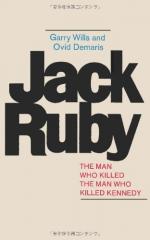
    Jack Ruby
    Jacob Rubenstein (March 25, 1911 – January 3, 1967), who legally changed his name to Jack Leon Rub... more


    Copyrights
    Jack Ruby from World of Criminal Justice. ©2005-2006 Thomson Gale, a part of the Thomson Corporation. All rights reserved.

    Join BookRagslearn moreJoin BookRags


    About BookRags | Customer Service | Report an Error | Terms of Use | Privacy Policy