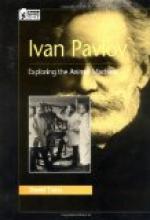
Ivan Pavlov is best known for his studies on the digestive systems which consequently led to the discovery of conditioned reflexes making it possible to study a purely physical reaction to an outside stimulus. His other major fields of study include research on the cardiovascular and nervous systems. I. M. Sechenov and his 1863 book Reflexes of the Brain were strong influences in Pavlov's life. Sechenov hypothesized about physical reflexes and their relation to psychic activity. This idea was the foundation upon which Pavlov based his experiments. Dogs were Pavlov's experimental animals, used in his research on the physiology of digestion that earned him a Nobel Prize in 1904. He noticed that when hungry dogs were presented with the thought of food, provoked by sight, sound, or smell, the dogs would salivate and produce gastric secretions, thus producing a physical response to external stimulus or a conditioned reflex. There was, until Pavlov's experiments, no known scientific explanation for this response.
Pavlov began his experiments on what was previously regarded as a psychic phenomenon from a physiological position. His research had a major effect on the world of psychology as well. One experiment performed involved ringing a bell when the food was presented to a dog. This elicited the response of salivation or the "conditioned reflex." If the variable of food is removed, the bell is still able to elicit salivation. On the contrary, if the bell is rung too many times and the food is not presented to the dog, the animal will stop salivating at the sound of the bell.
Pavlov's father was the village priest, so his schooling began in the field of theology, but due to his love of science, Pavlov decided that theology was not his true calling and in 1870 he began his education in physiology. By 1875, he received his degree of Candidate of Natural Sciences, and by 1879 he completed his studies at the Academy of Medical Surgery where he was awarded his second gold medal and a fellowship which allowed him to continue his studies.
In 1890 Pavlov was appointed a professor of Pharmacology at the Military Medical Academy, and the very next day after his appointment he was asked to organize and head the Department of Physiology at the Institute of Experimental Medicine. Until 1905, Pavlov did the bulk of his research at the Institute of Experimental Medicine. In 1905 the Physiological Laboratory was opened which allowed him to expand his research there, so that by 1917 he had about forty people working with him in the study of conditioned reflexes. In 1912 he was awarded an honorary doctorate from Cambridge University.
He married Seraphima Vasilievna Karchevskaya on May 1, 1881. She was a devoted and loving wife to him, and after a miscarriage with her first pregnancy and a sudden death of their son Wirchik, they had three more sons: Vladimir, Victor, Vsevolod and a daughter: Vera. Ivan was never very concerned with finances, so after many bad decisions with the family's money, Seraphima had to handle the financial responsibilities of the family and most other day-to-day issues since he was not adept in handling these matters. They remained together until Ivan's death on February 27, 1936 in Leningrad.
This is the complete article, containing 535 words
(approx. 2 pages at 300 words per page).