The major works of the German philosopher Immanuel Kant analyze speculative and moral reason and the faculty of human judgement. Kant exerted influence on the intellectual movements of the nineteenth and twentieth centuries. The fourth of nine children of Johann Georg and Anna Regina Kant, Immanuel Kant was born in Königsberg on April 22, 1724. In 1740 Kant entered the University of Königsberg where he became interested in philosophy, mathematics, and the natural sciences. Kant accepted the rationalism of Leibniz and Wolff and the natural philosophy of Newton until he read the works of David Hume.
Impoverished by the death of his father in 1746, Kant became a private tutor for seven years. He published several papers dealing with scientific questions, the most important of which was "General Natural History and Theory of the Heavens" (1755). Here Kant postulated the the solar system originated from the gravitational interaction of atoms. This theory anticipated Laplace's hypothesis (1796).
Kant spent the next 15 years (1755-1770) as a nonsalaried lecturer whose fees were derived entirely from the students who attended his lectures. In order to live he lectured between 26 and 28 hours a week on metaphysics, logic, mathematics, physics, and physical geography. Despite this enormous teaching burden, Kant continued to publish papers. He finally achieved a professorship at Königsberg in 1770.
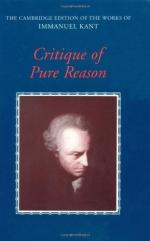
Kant produced Critique of Pure Reason (1781; second edition 1787), one of the most important and difficult books in Western thought which attempts to resolve the contradictions inherent in perception and conception as explained by the rationalists and empiricists.
Kant was the first thinker to posit the problem of pure reason correctly by isolating a third order of judgment. The fundamental propositions of mathematics, science, and metaphysics are synthetic a priori, and Critique of Pure Reason explores how understanding and reason can be known apart from experience. The solution to this problem is Kant's "Copernican Revolution." He bridged the widening gap between rationalism (Descartes, Leibniz, Spinoza) and empricism (Hobbes, Locke, Hume) in modern philosophy.
Unlike later idealists, Kant does not say that the mind creates objects but only the conditions under which objects are perceived and understood. These, for Kant, are the synthetic a priori truths that guide our experience. The attempt to preserve a realist orientation led Kant to distinguish between the appearances of things (phenomena ), as conditioned by the subjective forms of intuition, and the categories of the understanding and things-in-themselves ( noumena). In brief, mathematics and science are true because they are derived from the ways in which the mind conditions its percepts and concepts and metaphysics is an illusion because it claims to tell us about things as they really are.
The first critique attempts to reconcile the conflict between rationalism and empiricism over the role of experience. Kant's ingenuity is to suggest that both parties are correct but one-sided. The problem of the transcendental esthetic can be seen in the term "a priori intuition." That is, what does the mind tell us about experience prior to having experience? Kant argues that if one eliminates the content of any possible intuition, space and time remain as the a priori forms, or ways, in which the mind can perceive. Thus, for Kant, space and time are "transcendentally ideal" and "empirically real" as conditions of experience and objective, constitutive principles of intuition. Also necesary for experience is the trascendental unity of apperception, that one consciousness has experiences, thus unifying our perceptions. Here, Kant offers a solution to Hume's claim that there is no reason for connected experiences to be causally related. In effect, Kant simply says that cause and effect is a necessity for experience, positing it in the noumena, even though it cannot be justified in the phenomenal world.
Kant believed science is knowing and metaphysics is false, speculative thinking. Knowing is confirmed by experience as above, but the categories can be extended beyond space and time, and they, then, function as ideas of pure reason. Since metaphysics claims to speak about things as they are rather than as they appear, such pure thinking must justify itself without appeal to experience. But that is just the difficulty when one asks questions about the unconditioned reality of the self, world, or God. It is not that reason is incapable of producing arguments, but rather that there are equally valid arguments that contradict one another, and experience is unable to resolve these "antinomies," or seeming contradictions.
In 1783 Kant restated the main outlines of his first critique in a brief, analytic form in the Prolegomena to Any Future Metaphysics . In 1785 he presented an early view of the practical aspects of reason in Fundamental Principles of the Metaphysic of Morals . In 1788 he published the Critique of Practical Reason.
While theoretical reason is concerned with cognition, practical reason is concerned with will, or self-determination. There is only one human reason, but after it decides what it can know, it must determine how it shall act. Thus the freedom of the will, which is only a speculative possibility for pure reason, becomes the practical necessity of determining how one shall lead his life. And the fundamental, rational principle of a free morality is some universal and necessary law to which a man commits himself. This principle is called by Kant the "Categorical Imperative," which states that a man should obligate himself to act so that any one of his actions could be made into a universal law binding all mankind.
In 1790 Kant completed his third critique, which attempts to draw these conflicting tensions together. In pure reason the mind produces constitutive principles of phenomena, and in practical reason the mind produces regulative principles of noumenal reality. The Critique of Judgment attempts to connect the concepts of nature with the concepts of freedom.
Although Kant continued writing until shortly before his death, the "critical works" are the source of his influence. Only a life of extraordinary self-discipline enabled him to accomplish his task. He attributed his longevity to a fixed daily routine, consisting of meditation, study, lecturing, socializing with friends over dinner, and taking a long mid-afternoon walk. In old age, Kant became totally blind and died on February 12, 1804.
This is the complete article, containing 1,022 words
(approx. 3 pages at 300 words per page).