
 Print
Print Word
Word PDF
PDF|
This section contains 11,549 words (approx. 39 pages at 300 words per page) |

|
on Imamu Amiri Baraka
Biography Essay
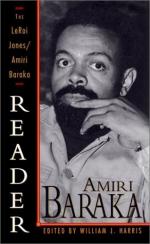
An influential figure among the literary avant-garde of Greenwich Village and the Lower East Side during the late 1950s and early 1960s, Amiri Baraka (known as LeRoi Jones until 1968) has been a seminal force in the development of contemporary Afro-American literature. Poet, music critic, essayist, dramatist, novelist, and political activist, Baraka's extraordinary talent and literary innovations have established him as a major writer. His prominence rests not only on his substantial literary achievement but also on the durability of his public personality, one whose extraliterary escapades and political activities have engaged the attention of his public for over two decades. Beginning in 1964, when the success of his play Dutchman established him as an outspoken commentator on American racial relations, Baraka has lived his artistic and political life in public view.
A protean personality, fond of manifestos and vehement repudiations, he has shifted guises and discarded identities...
|
This section contains 11,549 words (approx. 39 pages at 300 words per page) |
|



