
 Print
Print Word
Word PDF
PDF|
This section contains 6,555 words (approx. 22 pages at 300 words per page) |

|
Dictionary of Literary Biography on Ida B. Wells-Barnett
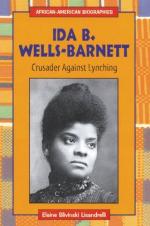
During her early twenties in Memphis, Tennessee, Ida B. Wells emerged as "the brilliant Iola," a pen name she often used as a journalist, whose forthright style and incisive political critique gained the attention and respect of a broad readership in what was then an almost exclusively male circle of black press professionals. Wells was to mature into a forceful journalist and editor, one who made her living by writing. She also emerged as a major, though always controversial, figure among those who crafted the African American political agenda for the twentieth century.
Throughout her public career, Ida B. Wells-Barnett consistently broke new political and professional ground. One of but a few black women in journalism, Wells became editor of her local black weekly, the Memphis Free Speech, in 1889. When that paper was destroyed in the aftermath of a lynching and her own life was threatened, Wells became...
|
This section contains 6,555 words (approx. 22 pages at 300 words per page) |
|



