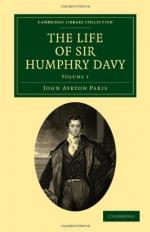
Humphry Davy grew up poor helping his mother pay off debts left by his father, a woodcarver who had lost his earnings in speculative investments. As a result, Davy's education was haphazard, and he disliked being a student. The schools in his part of the country (Cornwall, the southwest tip of England) were far from outstanding at that time. Still, Davy managed to absorb knowledge of classic literature and science. In later life, he said he was happy he didn't have to study too hard in school so that he had more time to think on his own.
Without money for further education, Davy began at age 17 to serve as an apprentice to a pharmacist/surgeon. During this time, he took it upon himself to learn more about whatever interested him, such as geography, languages, philosophy, and science. He also wrote poems that later earned him the respect and friendship of William Wordsworth, Samuel Coleridge, and other leading poets of his time. When he was 19 years old, Davy read a book on chemistry by the famous French scientist Antoine-Laurent Lavoisier that convinced him to concentrate on that subject. For the rest of his life, Davy's career was marked by brilliant, if impetuous, scientific explorations in chemistry and electrochemistry that led to the numerous discoveries for which he is known today.
One of Davy's scientific trademarks was his willingness, even eagerness, to use himself as a guinea pig. In early tests with hydrogen, for example, he breathed four quarts of the gas and nearly suffocated. He also tried to breathe pure carbon dioxide, which is actually a product of human respiration. These experiments were conducted while Davy was working at an institute for studying the therapeutic properties of various gases.
In one instance, Davy's fondness for risk paid off. While studying nitrous oxide gas, he discovered that its unusual properties made him feel giddy and intoxicated. When he encouraged his friends to inhale the gas with him, he found that their inhibitions were lowered and their feelings of happiness or sadness intensified. Davy's poet friend Robert Southey (1774-1843) referred to his experience as being "turned on," and nitrous oxide became known as laughing gas. Beyond Davy's circle, nitrous oxide parties became a fad among the wealthy people. Davy recognized, however, that the gas could be used to dull physical pain during minor surgery. Although the medical profession ignored Davy's discovery for nearly half a century, nitrous oxide eventually became the first chemical anesthetic. In an 1844 experiment, a dentist had one of his teeth extracted successfully while under the influence of nitrous oxide (having first taken the precaution of writing his will). Some dentists still use the gas today for apprehensive patients.
Davy was also known for his skill as a public speaker. In the early 1800s, he was hired to lecture for the Royal Institution, a new scientific institution that was having financial problems. Davy's poise and the polish of his lectures and demonstrations drew enthusiastic crowds from London's high society and soon reversed the institution's fortunes. (Some historians have also referred to Davy's good looks, which probably contributed to his popularity with the fashionable women in the audience.)
After a brief foray into agricultural chemistry, Davy entered his most prolific period of discovery. His style in the laboratory was to work quickly and intensely, pursuing one new idea after another. He aimed at originality and creativity, rather than tediously repeating tests and confirming results. Stimulated by the Italian physicist Alessandro Volta's invention of the electric battery, Davy rushed into the new field of electrochemistry and, in 1805, produced an electric arc by making a strong current leap from one electrode to another. This discovery led to arc lighting and arc welding, which are still in use today.
Greatly excited with this new tool of electricity, Davy went on to build his own large battery--the strongest one at the time--and used it to decompose substances most scientists thought were pure elements. According to many sources, Davy danced around the room exuberantly when he discovered the element potassium, which he created by electrolyzing potash. Just a week later, he isolated sodium from soda in a similar way. Then, using a slightly modified method, he isolated the elements calcium, magnesium, barium, and strontium.
By this time other scientists, spurred by Davy's triumphs, had begun to compete with him. Although Davy discovered boron, French chemists Joseph Gay-Lussac and Louis Thénard also received credit for their boron experiments. Indeed, Gay-Lussac and Davy mined the same fields for a time. And while Davy proved that hydrochloric acid did not contain oxygen (which contradicted the prevailing theory), Gay-Lussac did the same for prussic acid. Both of them showed that iodine, discovered by French chemist Bernard Courtois (1777-1838), was an element. In his analysis of hydrochloric acid. Davy identified a greenish-colored gas and named it chlorine, after the Greek word for green. This work led to his proof that chlorine also was an element. Davy was also the first to notice that platinum could catalyze, or speed up, chemical reactions--a discovery that would later be exploited to a much greater extent.
While in his early thirties, after being knighted in 1812, Davy married a wealthy Scottish widow and began to travel extensively, enjoying his fame wherever he went. In Italy, using a great microscopic lens available in Florence, he studied diamonds and concluded that they are a form of carbon. Davy was accompanied on some of these trips by his assistant/valet Michael Faraday, who was destined to eclipse his mentor's reputation in the realm of science.
After returning to England, Davy was summoned to study coal-mine explosions, which were killing hundreds of miners yearly. He invented a miner's safety lamp, also called the Davey lamp, in less than three months. While testing samples of the "fire-damp" gas that caused the explosions, he verified that it was mostly methane and that it would ignite only at high temperatures. In Davey's lamp, wire gauze surrounds the flame to dissipate heat and prohibit the natural gases from igniting. The invention of this lamp marks the first major attempt at safety in the coal mining industry.
Davy's work was rewarded by many honors and medals. In addition to his knighthood, he was made a baronet in 1818 for his service to the mining industry and was elected president of the prestigious Royal Society in 1820. In his conflicts with other scientists, however, Davy made some enemies who thought he was arrogant. He even tried to prevent his associate Faraday from being elected to the Royal Society.
Health problems began to plague Davy while he was still in his thirties. The same curiosity that drove him to discover and invent with such success had also taken its toll on his body. By sniffing and tasting unknown chemicals, he had poisoned his system, and his eyes had been damaged in a laboratory explosion. Although Davy continued to pursue scientific interests, he suffered a stroke when he was only 49 and died abroad just two years later.
This is the complete article, containing 1,163 words
(approx. 4 pages at 300 words per page).