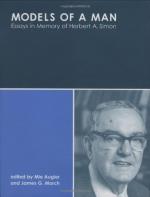
|
This section contains 1,063 words (approx. 4 pages at 300 words per page) |

World of Computer Science on Herbert A. Simon
Generally considered one of the fathers of artificial intelligence--computer programs capable of complex problem-solving--Herbert A. Simon made distinguished contributions in a number of fields, including computer science, the psychology of learning, business administration, political science, economics, and philosophy. Recipient of the 1978 Nobel Prize in economics for his work on human decision-making, he also, in 1986, became the first person to receive the National Medal of Science for work in the behavioral sciences. In addition to his varied professional interests, he also painted, played the piano, and enjoyed mountain-climbing, traveling, and learning foreign languages. He died February 9, 2001 from complications following surgery to remove a cancerous tumor from his abdomen.
Simon was born in Milwaukee, Wisconsin, on June 15, 1916. His father, Arthur Simon, was a German-born electrical engineer and his mother, Edna (Merkel) Simon, was an accomplished pianist. After being skipped ahead three semesters in the Milwaukee public school system, Simon was just seventeen when he enrolled in the University of Chicago, where he would earn his B.A. in political science in 1936. As an undergraduate, Simon conducted a study of the administration of the Milwaukee Recreation Department. This study sparked Simon's interest in how administrators make decisions--a topic that would be a focal point of his career. In 1937, Simon married Dorothea Isobel Pye, also a graduate student in political science at the University of Chicago; they would have three children, Katherine, Peter, and Barbara.
After graduating, Simon was hired by the International City Managers' Association (ICMA) in Chicago as an assistant to Clarence Ridley, who had been his instructor in a course on evaluating municipal governments. Ridley and Simon became widely recognized experts on mathematical means of measuring the effectiveness of public services. While at the ICMA, Simon had his first experience with computers. As an assistant editor of the Municipal Yearbook, Simon started using IBM keypunch, sorting, and tabulating machines to prepare statistical tables. His consequent fascination with these machines would play a major part in his research and his career.
In 1939 Simon moved to the University of California at Berkeley to head a three-year study of local government funded by a grant from the Rockefeller Foundation. While at Berkeley, Simon completed the requirements for his Ph.D. from the University of Chicago. His dissertation, on decision-making in organizations, later evolved into his first book, Administrative Behavior. In 1942, Simon joined the faculty of the political science department at the Illinois Institute of Technology, where he remained for seven years, becoming department chair in 1946. Then, in 1949, he was tapped by the Carnegie Institute of Technology (later known as Carnegie-Mellon University) in Pittsburgh, Pennsylvania, to teach in its new graduate school in business administration. Simon would play a major role in shaping the curriculum, which was designed to provide students with the basic tools necessary for independent learning and problem-solving.
In his autobiography, Models of My Life, Simon describes 1955 and 1956 as the most important years of his scientific career. It was at this time that Simon, along with Allen Newell and Clifford Shaw of the RAND Corporation, began using computers to study problem-solving behavior. To do this, they observed individuals as they worked through well-structured problems of logic. Subjects verbalized their reasoning as they worked through the problems. Simon and his colleagues were then able to code this reasoning in the form of a computer program. The program was not subject-matter specific; rather, it focused on the problem-solving process. Together, Simon, Allen, and Shaw developed Logic Theorist and General Problem Solver, the first computer programs to simulate human reasoning in solving problems. This work was at the forefront of the newly developing field of artificial intelligence. Simon and J. R. Hayes later developed the "Understand" program, which was designed to allow computers to solve even poorly structured problems. The program first worked to define the problem, and then focused on the problem's solution. Simon's work in artificial intelligence would lead to his being named Richard King Mellon University Professor of Computer Science and Psychology at Carnegie-Mellon University in 1966.
In 1957 Simon released a second edition of Administrative Behavior. In the new edition, Simon built on his original contention that because of the complexity of the economy, business decision-makers are unable to obtain all of the information they need in order to maximize profits. As a result, he had argued, most companies try to set goals that are acceptable but less than ideal--a behavior he termed "satisficing." In the second edition, Simon pointed out that his findings undermined a basic assumption of classical economic theory that the decision maker in an organization has access to all of the information needed to make decisions and will always make rational decisions that maximize profits. Simon's conclusions met with resistance from many economists, although those specializing in business operations were more accepting.
Simon's distinguished career received significant recognition in the 1960s and 1970s. He was elected to the National Academy of Sciences and became chairman of the Division of Behavioral Sciences for the National Research Council in 1967; the following year, he was appointed to the President's Science Advisory Committee. In 1969, Simon received the American Psychological Association's Distinguished Scientific Contributions Award, and in 1975, he shared the Association for Computing Machinery's A. M. Turing Award with his long-time collaborator Allen Newell. This string of awards and honors culminated in 1978 when he was awarded the Nobel Prize in economic science for his research into the decision-making process within organizations.
In the 1980s, Simon continued to be an active researcher, with his work including a study of short-term memory with colleagues from China. He continued his activity with the National Academy of Sciences and published a second volume of Models of Thought in 1989. In 1991, he published his autobiography, Models of My Life. In the introduction to this book, Simon commented on the varied academic paths he has chosen: "I have been a scientist, but in many sciences. I have explored mazes, but they do not connect into a single maze. My aspirations do not extend to achieving a single consistency in my life. It will be enough if I can play each of my roles creditably, borrowing sometimes from one for another, but striving to represent fairly each character when he has his turn on stage."
Simon died on February 9, 2001, in Pittsburgh, Pennsylvania, of complications following surgery in January. He was 84.
|
This section contains 1,063 words (approx. 4 pages at 300 words per page) |