
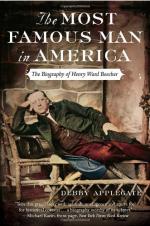
Dictionary of Literary Biography on Henry Ward Beecher
Henry Ward Beecher (24 June 1813-8 March 1887) was the most popular preacher in America during the middle decades of the nineteenth century. Known for his outspoken positions on the temperance, abolitionist, and women's rights issues, Beecher was also admired for the more than 100 lyceum lectures which he delivered every year after 1855. Yet the greatest source of his success and popularity was his instrumental role, both as a writer and editor, in the rapidly growing religious periodical press at mid-century. Although his work at times was overshadowed by the fame achieved by his sister, Harriet Beecher Stowe, Henry was a prolific writer, author of one novel and more than twenty-three volumes of sermons and articles, who was universally recognized as a leading spokesman for popular Protestant middle-class values.
Born in Litchfield, Connecticut, the eighth child of Lyman Beecher, a leading revivalist preacher, Henry Ward Beecher had a natural interest in religion. Like his five brothers who also entered the ministry, Beecher began his religious studies early, first at Mt. Pleasant Academy in Massachusetts, then at Amherst College where he graduated in 1834, and finally at Lane Seminary in Cincinnati, where his father had gone in the hopes of sparking a revival in the Ohio River Valley. After his marriage to Eunice Bullard White in 1837 and an early pastorate at the First Presbyterian Church in Lawrenceburg, Indiana, where he developed his preaching style and moved away from the revivalism of his father to a more supportive faith, Beecher received a call to the Second Presbyterian Church in Indianapolis. In that city, Beecher first achieved a national reputation with the publication in 1844 of his melodramatic advice book, Seven Lectures to Young Men, on Various Important Subjects, which was eventually reprinted nine times.
Beecher's advice book, together with his opposition to slavery and his superb speaking ability, brought him to the attention of some liberal Congregational businessmen in Brooklyn who invited him to become their minister in 1847. Beecher quickly accepted their offer to head the new Plymouth Church, both because his wife was sick and needed to leave the malarial conditions in Indianapolis, and because he recognized the importance of being near the publishing centers in New York City. He was convinced that the success of the Congregational Church depended upon its ability to mold public opinion through the pulpit and the press. Once in Brooklyn, Beecher joined a Protestant newspaper, the Independent, and began to write weekly articles on subjects of general interest. Having edited the Cincinnati Journal and the Indiana Farmer and Gardener in Indianapolis, Beecher quickly put his extensive knowledge of natural history to use. His articles, with titles that ranged from "Building a House" and "Christian Liberty in the Use of the Beautiful" to "A Discourse on Flowers" were gathered into two volumes, Star Papers; or, Experiences of Art and Nature and Plain and Pleasant Talk about Fruits, Flowers and Farming. In a graphic and humorous way, Beecher used these articles to develop a new romantic Christianity which preached God's love for man and stressed the regenerating power of the natural world. It was a gospel of hope and strength, which appealed to a generation of Americans who were beginning to move from the farm to the city.
Beecher also attracted public attention in the 1850s through his outspoken attack on slavery. Active in his support of the Republican Party in 1856, Beecher soon gained an influence in national politics. When war broke out in 1861, he helped raise a new regiment in Brooklyn and supported the Northern war effort with strong articles in the Independent, which he also edited between 1861 and 1864. Beecher's outspoken attack on slavery helped push Lincoln to issue the Emancipation Proclamation and a speaking tour in England in 1863 helped build support for the Northern war effort. Beecher's political speeches, later published as Patriotic Addresses and as Lectures and Orations, identified the cause of the state with that of the church. As the leading spokesman for popular Protestantism, Beecher combined an emphasis on moral duty and national destiny. Working for the church would help to build a stronger nation.
After the war and a brush with public censure for briefly supporting the reconstruction position of President Andrew Johnson, Beecher entered on his greatest publishing successes. For the spectacular offer of $24,400 he wrote a serialized novel, Norwood; or, Village Life in New England, for Robert Bonner's New York Ledger , whose circulation was 400,000 at a time when Hawthorne's The Scarlet Letter (1850) sold less than 10,000. Beecher's novel, subsequently published separately as a book in 1867, was ostensibly a story of two pairs of young lovers, one from the North and the other from the South; one romance resulted happily in marriage and the other in the death of the secondary hero, who was fighting for South Carolina, at Gettysburg. As fiction, the novel is the work of a clever amateur. Its importance lies rather in the systematic exposition of popular liberal Protestantism. Like his sermons which were filled with graphic images drawn from everyday life, Beecher's novel exemplified moral principles at work in real-life situations. It preached a God of love and forgiveness, whose moral principles were everywhere reflected in the world of nature.
Beecher's successful novel was followed by the publication of ten volumes of sermons, a book of newspaper articles, and the editorship (1870-1884) of a new religious periodical, the Christian Union (later called the Outlook). When Beecher was accused in 1874 of having committed adultery with Elizabeth Tilton, the wife of the editor of the Independent , the resulting national scandal was motivated in part by the competition between the Independent, which Beecher had left, and the Christian Union. The scandal, which made the front page of the New York Times for six months, ended in a hung jury at Beecher's trial for adultery, divided nine to three in favor of his innocence. Instead of undermining his popularity, the scandal enhanced it. In the next year, Beecher traveled 27,000 miles and lectured in eighteen states as well as Canada, earning more than $60,000. Since Beecher was a leading national spokesman for the middle-class values of honesty, morality, and familial love, most Americans refused to believe that he might have been guilty.
In the 1880s Beecher turned his attention to the controversy over Darwinism. Calling himself a "cordial Christian Evolutionist," Beecher discarded the destructive aspects of Darwin's theory and harnessed evolution to his own theory of progress. The continuing spiritual and physical development of the nation, he argued in his book, Evolution and Religion, would overcome want and solve the nation's social problems.
Beecher intended to write his autobiography, but he died shortly after the project was begun. Not a first-rate writer or thinker, Beecher nevertheless inspired a generation of middle-class Americans and taught them to be proud of their own accomplishments. As he himself admitted, "I am not one of the largest natures. I know my place and rank, I think. I belong to the second [among] men. I shall do good while I am alive, not so much in discovering or organizing truth, as in applying it, and rousing men to activity."
This is the complete article, containing 1,193 words
(approx. 4 pages at 300 words per page).

