|
This section contains 529 words (approx. 2 pages at 300 words per page) |

World of Criminal Justice on Harry Micajah Daugherty
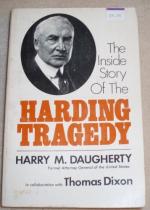
Harry Micajah Daugherty served as U.S. attorney general from 1921 to 1924 under Presidents Warren Harding and Calvin Coolidge. An Ohio lawyer and Republican Party operative, Daugherty became attorney general after managing Harding's 1920 presidential campaign. He left office in disgrace, however, accused of political graft and corruption.
Daugherty was born on January 26, 1860, in Washington Court House, Ohio. He earned a law degree from the University of Michigan in 1881 and was admitted to the Ohio bar. After establishing a law practice in his hometown, Daugherty became involved in local politics. He soon earned a reputation as an attorney who knew how to use political connections to influence the outcome of events. Daugherty served as township clerk before being elected to the Ohio House of Representatives in 1890. He served two terms but left in 1894 to reestablish his law practice in Columbus, Ohio. Although he failed to be elected either as Ohio attorney general in 1895 or as governor in 1897, Daugherty combined a lucrative corporate law practice with Republican Party politics.
Acquainted in 1902 with Warren Harding during his campaign for lieutenant governor, Daugherty went on to manage the remainder of Harding's campaigns, including the 1914 U.S. Senate election. Over time, Daugherty and a group of political cronies played a major role in Harding's political career. Daugherty, who had no illusions about Harding's leadership abilities, promoted him at the 1920 Republican Convention as a compromise candidate. When the convention deadlocked, Daugherty and other party leaders met privately and selected Harding.
Harding rewarded Daugherty by naming him attorney general in 1921. Daugherty and the rest of the group the press labeled "the Ohio gang" came to Washington, D.C. and embarked on various courses of self-enrichment, many of them illegal. Though Daugherty was not directly involved in the Teapot Dome scandal, Congress and the public lost confidence in him when he failed to conduct a vigorous examination of corruption charges. Daugherty was accused of obstruction of justice as the scandal dragged on over the bribery by two oil executives of Secretary of the Interior Albert Fall.
Daugherty himself soon came under suspicion for corruption. He was accused of defrauding the government in the disposal of alien property confiscated by his office from German nationals. Congress, infuriated at his actions, twice sought to remove him from office. Daugherty maintained his innocence and remained in office. However, his standing in office became precarious when Harding died suddenly in 1923.
Harding's successor, President Calvin Coolidge, agreed with Congress that Daugherty had not investigated the Teapot Dome enough and a host of other political corruption charges involving Harding's cronies. Therefore, he appointed a special prosecutor to independently investigate these charges. When Daugherty refused to turn over his records on these investigations to congressional investigators, Coolidge had seen enough. He demanded that Daugherty submit his resignation.
After leaving office, Daugherty was charged with graft and fraud while serving as attorney general. He was tried on these charges twice in 1927, but both cases ended in a hung jury. He returned to Ohio and his law practice but spent much of his time trying to rescue his and Harding's reputation. He died on October 12, 1941, in Columbus, Ohio.
|
This section contains 529 words (approx. 2 pages at 300 words per page) |