
BookRags.com Literature Guides Literature Guides Criticism/Essays Criticism/Essays Biographies Biographies My Bibliography Periodic Table U.S. Presidents Shakespeare Sonnet Shake-Up
Research Anything:        
History | Encyclopedias | Films | News | Create a Bibliography | More... Login | Register | Help

Search "(Harold) Hart Crane"

Biographies Navigation
 

(Harold) Hart Crane Biography

Print-Friendly  Order the PDF version  Order the RTF version
About 4 pages (1,310 words)
Hart Crane Summary

Bookmark and Share
Name: Hart Crane
Birth Date: July 21, 1899
Death Date: April 26, 1932
Place of Birth: Garrettsville, Ohio, United States
Nationality: American
Gender: Male
Occupations: poet

Dictionary of Literary Biography on (Harold) Hart Crane

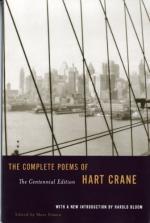
Like many other American writers of the twenties Hart Crane visited France. Crane's stay, which lasted from early January to mid-July 1929, was briefer than most. The poet had hoped that France would be a place where he could work on his epic The Bridge (1930), free from interruptions by family and friends. Having published one book of poems, White Buildings , in 1926 as well as numerous poems in little magazines, Crane was anxious to finish what he considered to be his most important work and the one on which his reputation would be made.

Crane was born "with his little toe in the last century," as he put it, on 21 July 1899 in Garrettsville, Ohio. His parents' married life was one of considerable strain, which was reflected in their relations with their only son. In December 1916, when his parents were filing for a divorce, Crane moved to New York to begin his career as a writer. Before going to France in 1929, Crane lived in New York City, Cleveland, upstate New York, Los Angeles, and Cuba.

Even after his parents' divorce Crane found himself caught in their tug-of-war for his affections. It was perhaps these strains that contributed to the poet's reliance on alcohol, which he contended enhanced his artistic abilities, and to his homosexuality. His life can be regarded as a series of flights from those around him who knew of the intimate details of his experiences: from his mother, to whom he confided his homosexuality in the spring of 1928; from his father and acquaintances in Cleveland, who he feared would soon learn; and from his friends in New York to whom his drinking and sexual exploits had become legendary. Aided by a legacy from his maternal grandparents, Crane set sail for Europe on the Cunard Lines' Tuscania on 8 December 1928. After spending Christmas in London with Laura Riding and Robert Graves, Crane left for Paris on 6 January 1929.

The first person Crane visited after his arrival in Paris was Eugene Jolas. Jolas, who had corresponded with Crane since 1927, had translated Crane's poem "O Carib Isle" into French for his Anthologie de la Nouvelle Poesie Americaine (1928) and had published several others in his little magazine transition. Jolas introduced Crane to a small circle of artists and writers including Eva Gautier, Philippe Soupault, Laurence Vail, Kay Boyle, and most importantly, Harry and Caresse Crosby. Within days of his arrival Crane wrote on a postcard to a friend in New York, "Dinners, soirees, poets, erratic millionaires, painters, translations, lobsters, absinthe, music, promenades, oysters, sherry, asprin, pictures, Sapphic heiresses, editors, sailors, And How!" His enthusiasm for his new environment had a positive effect on his writing.

No doubt Crane had the Crosbys in mind when he wrote of "erratic millionaires" on his postcard. The Crosbys, who owned the Black Sun Press, were enthusiastic about The Bridge and made arrangements to publish the first edition. Crane also showed the Crosbys the manuscript for his friend Malcolm Cowley's Blue Juniata (1929), and the Crosbys considered publishing it until Crane received word from Cowley that the book had been accepted for publication in New York. Though Harry Crosby possessed a self-destructive nature that often has been compared to Crane's, he initially served as a positive force by providing the poet with the isolation they both felt was necessary to finish his great work. In February 1929 Crosby gave Crane the use of the Moulin du Soleil, his country retreat at Ermenonville outside Paris. The several weeks he spent at Ermenonville marked the first time in more than a year that Crane had been able to concentrate on his poetry, and he went back to work on The Bridge. By the end of the month, after several weeks of reading and note-taking, he had roughed out a draft of the "Cape Hatteras" section, the only significant poetry he wrote in France and one of the most important sections of his epic.

In March, however, Crosby enticed Crane to a chaotic round of parties and social engagements, and his work on the poem ceased. Between visits to the Crosbys, Crane met Gertrude Stein, saw his friends Allen Tate and Caroline Gordon, and gradually extended his circle of friends to include a group of young French and American artists and writers, of which Eugene MacCown, Allen Tanner and his sister Florence were a part. The pace in Paris was too much even for Crane, so in April and May he visited Collioure and Marseilles in the South of France. He was not without remorse over the brevity of his creative period and wrote friends in America: "I've been ... hoping ... that I'd have more 'progress' to report than the usual preoccupations of a typical American booze-hound in Paris.... However, as regards creative writing--I can't say that I'm finding Europe extremely stimulating...." Crane did some work in Marseilles, though. It was there that he wrote the gloss that accompanies The Bridge and helps to bind the poem together.

Crane returned to Paris in late June 1929. "Hart C. back from Marseilles where he slept with his thirty sailors and he began again to drink Cutty Sark..." Harry Crosby somewhat dramatically recorded in his diary. The entry marks the beginning of Crane's final and most spectacular binge in Paris. After a fight in the Cafe Select, Crane was arrested, beaten by the Paris police, and incarcerated in La Sante for a week until Crosby paid Crane's fine and advanced him money for the passage home. On 18 July 1929, six and a half months after his arrival, and four days before his thirtieth birthday,Crane embarked on the S.S. Homeric for New York. His first and only trip to Europe was at an end.

Crane's association with the Crosbys did not end when the poet left Paris. Indeed, he was with Caresse Crosby on 10 December 1929, when she learned of her husband's suicide, and Caresse Crosby oversaw the publication of the Black Sun Press edition of The Bridge in early 1930. After the book's publication they drifted apart. "To the Cloud Juggler," Crane's poem in memory of Harry Crosby, appeared in the June 1930 issue of transition.

Until his death by suicide in 1932, Crane lived in various places including New York City, Ohio, and Mexico, where he went on a Guggenheim fellowship in 1931. There he became increasingly frustrated at his inability to complete poems that he considered first rate, drank himself into madness, and often found himself in trouble with the Mexican authorities. On his return to New York City in April 1932 Crane jumped from the stern of his steamship and drowned.

Surely one of the most difficult sections in what many consider as an altogether difficult poem, "Cape Hatteras" stands with "Cutty Sark" as the pivotal point of The Bridge. Several recent critics, including R.W.B. Lewis and Robert L. Combs, regard it as containing some of the most remarkable lines Crane wrote, but earlier critics like Yvor Winters and Allen Tate felt that the poet had overly sentimentalized Walt Whitman's Passage to India. Whatever the critical reception, most agree that "Cape Hatteras" grasps for the experience of space and the transcendence of old values: "Thou hast there in thy wrist a Sanskrit charge / To conjugate infinity's dim marge--/ Anew ...!" The poem, like others he wrote, affirms the ability of the human spirit to renew itself. The tone alternates between pessimism and optimism. While acknowledging man's technological triumphs, Crane questions the purposes to which they have been put. "Cape Hatteras" ends in affirmation as the poet envisions himself moving in the tradition of Whitman, celebrating the engineers and traveling "onward and without halt" toward the future. In this way "Cape Hatteras" may be interpreted as reflecting the state of Crane's mind in Paris, when--if only briefly--he made a new beginning and renewed his spirit.

This is the complete article, containing 1,310 words (approx. 4 pages at 300 words per page).

View More Summaries on Hart Crane
More Information
  • View (Harold) Hart Crane Study Pack
  • Search Results for "(Harold) Hart Crane"
  • Add This to Your Bibliography
  • More Products on This Subject
    Hart Crane
    The years immediately preceding World War I saw the introduction of international modernism to Amer... more

    Hart Crane
    Hart Crane (1899-1932) was an American poet in the mystical tradition who attempted, through the vi... more


    Copyrights
    Thomas S.W. Lewis, Skidmore College. (Harold) Hart Crane from Dictionary of Literary Biography. ©2005-2006 Thomson Gale, a part of the Thomson Corporation. All rights reserved.

    Join BookRagslearn moreJoin BookRags


    About BookRags | Customer Service | Report an Error | Terms of Use | Privacy Policy

