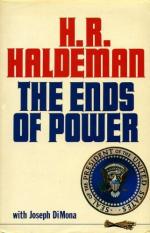
A government official, business consultant, and author, H. R. Haldeman gained notoriety for his involvement in the 1972 Watergate scandal--a scheme devised by top-ranked government officials, including President Richard M. Nixon, to cover up the Committee to Reelect the President's connection with the burglary of the Democratic National Committee headquarters. For his role in the conspiracy, Haldeman, Nixon's chief of staff, was forced to resign from his position and was later indicted on conspiracy, perjury, and obstruction of justice charges. He spent eighteen months in California's Lompoc prison farm. When he was released, he distanced himself from politics, becoming involved instead with business and real estate ventures and working as a business consultant.
Haldeman's position as a top government aide afforded him the rare opportunity to work with the president on a daily basis. Commenting on his association with Richard Nixon, he noted: "[Nixon] didn't see me as a person or even, I believe, as a human being. I was a machine. A robot. Shortly after it came out, I saw the movie 'Star Wars.' There is a robot, a metal machine clanking along doing what it's told by a computer-like mind. From Nixon's standpoint, that's what I was."
Upon request of the president, Haldeman and Ehrlichman submitted their resignations after they became implicated in cash payments to Watergate defendants. Upon resigning, Haldeman found himself abandoned by his former associates in the capital and a target of a Senate investigation. After he was found guilty of perjury, Haldeman reflected: "My part in this program was wrong. I am deeply sorry for every act of mine that furthered this effort."
While in prison Haldeman had an opportunity to watch David Frost's televised interviews with Nixon. According to Time, "Haldeman had fumed as he watched his former chief imply...that he might have saved his presidency if he had just had the heart to fire earlier his two closest aides, Haldeman and domestic adviser John Ehrlichman. Haldeman vowed then and there to turn his pro-Nixon memoirs into a stinging expose of 'the truth' about Watergate."
Haldeman's "expose," The Ends of Power, is regarded by many as something less than the "truth" Haldeman had "vowed" to tell. Time deemed it "badly flawed, frustratingly vague and curiously defensive. Many key sections were promptly denied; others are clearly erroneous." And former associate Ehrlichman wrote of the book's "material, factual errors which impeach its substance."
However, despite some harsh criticism, Ehrlichman nurtured some hope for Haldeman and his literary future. "Bob Haldeman was in a unique position to write a truly valuable book about Richard Nixon. I hope that The Ends of Power is not his last word."
This is the complete article, containing 436 words
(approx. 1 page at 300 words per page).