
BookRags.com Literature Guides Literature
Guides
Criticism & Essays Criticism &
Essays
Questions & Answers Questions &
Answers
Lesson Plans Lesson
Plans
My Bibliography Periodic Table U.S. Presidents Shakespeare Sonnet Shake-Up
Research Anything:        
History | Encyclopedias | Films | News | Create a Bibliography | More... Login | Register | Help

Search "Gwethalyn Graham"

Biographies Navigation
 

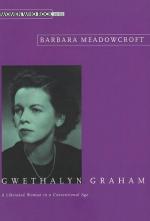
Gwethalyn Graham Biography

Print-Friendly  Order the PDF version  Order the RTF version
About 5 pages (1,492 words)
Gwethalyn Graham Summary

Bookmark and Share Questions on this topic? Just ask!
Name: Gwethalyn Graham
Variant Name: Gwethalyn Graham Erichsen Brown|Gwethalyn Graham Erichsen-Brow
Birth Date: January 18, 1913
Death Date: November 25, 1965
Nationality: Canadian
Gender: Female

Dictionary of Literary Biography on Gwethalyn Graham

Gwethalyn Graham's two published novels, Swiss Sonata (1938) and Earth and High Heaven (1944), both won awards in Canada. But it is the spectacular critical and popular success of her second novel which established her as internationally known writer, and it is for this novel that she is best remembered.

Graham was one of the barbingers of a new spirit in Canadian literature; she belongs to that group of Canadian novelists, which includes such writers as Frederick Philip Grove, Hugh MacLennan, and Gabrielle Roy, who were the first to deal seriously and realistically with the problems of contemporary Canada. Central to her work is an abiding concern for the rights of the individual in society, and there are strong indications in her family background that the experience of her early childhood and adolescence shaped her vision as a writer to a considerable degree.

Graham was born Gwethalyn Graham Erichsen-Brown in Toronto on 18 January 1913. Her family had for generations been active supporters of civil liberties and human rights. Graham's father, Frank Erichsen-Brown, was a lawyer and amateur painter; her mother, Isabel Russell MacCurdy Erichsen-Brown, was a leader in the Canadian woman suffrage movement. Graham enjoyed meeting visitors in the home of her parents, but the greatest impact upon her youthful sensibilities was made by her much-admired maternal grandfather, James F. MacCurdy, a noted Orientalist at the University of Toronto. Of him, she said: "He was an individualist in the finest sense of the word and I remember that he would not tolerate the use of any of the derogatory slang words which label national or religious groups on this continent"

Later Graham frequently expressed her appreciation for the intellectual stimulus,us provided by these early relationship and contacts and the liberal ambiance. However, according to accounts of friends and family and the evidence in "West Wind," her thinly veiled autobiographical novel which has never published, there was as well much unhappiness in her life. Her power to covey in her novels the pain of an outcast,s existence had in some measure been honed by her own experience as a lonely adolescent outsider, out of step with her peers because of her unusual; height and size for her age. Although a brilliant student, life at a Toronto private school was an agony for the painfully self-conscious Graham. Nor did the emotional tenor of her situation improve markedly at a finishing school in Lausanne, Switzerland, which she entered in the fall of 1929. She did, nevertheless, form some lasting friendships there with girls of different nationalities; these relationships later formed the basis for Swiss Sonata .

Smith College in Massachusetts, to which she was admitted in the fall of 1931, was a happier and more successful experience. Her formal studies, however, were ended abruptly when at the beginning of her second year at Smith, at age nineteen, she eloped with John McNaught, the son of C. B. McNaught, a prominent Canadian financier. John McNaught formed a liaison with another woman shortly after his marriage to Graham; divorce proceedings were begun before their son, Anthony, was a year old. In the latter part of 1934 Graham and her son moved to Montreal, a city she loved, and she started to work on Swiss Sonata and "West Wind." Following her divorce Graham lived on a fixed allowance, and beginning in 1937 she sporadically supplemented her income by buying and selling books for her British publisher, Jonathan Cape.

Swiss Sonata was published in Great Britain and the United States ion earl;y 1938, went through two British editions, won a Governor General's Award in Canada, and is reported to have been banned in Nazi Germany. The very good press it received established its author as a promising young writer. The setting of Swiss Sonata is a Swiss pensionnat, or boarding school, for girls; the time is January 1935, the politically ominous and tense period in Europe just before the Saar plebiscite; and the story is a reflection of the racial conflicts and alienation developing in the world in the years before World War II. Jew-baiting and factionalism among the students from many nations threatens the headmistress's cherished goal to "inculcate the international idea in minds which are not yet too set, too limited by prejudice, too mired in conventional patriotism."

A passionate argument for international co-operation forms one movement of Graham's "sonata." Also important is the existential theme of commitment to something larger than one's self as an antidote to the loneliness and vacuity of life. The novel is marred by an unwiedly cast of twenty-seven characters, the superintricacy of its plot, and the implausibility of the events taking place in a single day. But its notable achievements more than offset these failings, for the witty and often humorous dialogues ring true, and most of the characterizations are vivid and powerful. Reviews in Great Britain, the United States, and Canada were generally favorable.

Following the publication of Swiss Sonata, Graham spent some six months in mid 1938 in Europe, where she witnessed and was deeply moved by the plight of the homeless victims of Hitler's Anschluss. When she returned to Canada, it was to Toronto, the center of the Canadian publishing trade as well as her family home. In Toronto in the fall of 1938, she wrote two well-documented articles for Saturday Night, arguing for the admission of refugees into Canada, and she gathered petitions and made speeches on the refugees' behalf. In the course of these activities she met and became emotionally involved with a Jewish Canadian lawyer whom her father declined to meet. The relationship came to an end, and Graham returned to Montreal, where she wrote Earth and High Heaven.

Earth and Heaven, set against the background of World War II, concerns two young people who meet by chance, fall in love, and attempt to transcend the racial prejudice all around them. The girl is Erica Drake of the prominent Drakes in Montreal's upper-class WASP establishment the man is Marc Reiser, a lawyer and an army captain waiting to be sent overseas. He is also the first-generation son of immigrant Jews from a small Ontario town. Erica is shocked to discover that her father, Charles Drake, a cultivated and enlightened man of professedly liberal views, will not countenance the marriage of his daughter to a Jew. The narrative is shaped by the struggle between Erica and her father. Charles Drake's grim psychological maneuverings to destroy his daughter's attachment are focus of study of a man harboring within himself conflicting values and unexamined emotions towards his daughter. He finally attains self-awareness under the double onslaught of losing a son in the war and almost loosing his daughter. His sudden reversal provides the novel's "happy" ending with the two lovers about o be married. In the father-daughter conflict anti-Semitism stands revealed in its baneful affects upon Jew and Gentile alike. Prejudice engulfs Charles Drake's humane instincts and judgment to the point that he accepts and repeats the false generalizations and cheap innuendoes circulating in his milieu about "Jews." In contrast, sensitive Marc Reiser accepts the mort-main of traditional bias and sinks into a state of hopelessness.

Earth and High Heaven, written with a compelling intensity of conviction, won the acclaim of critics and captured the imagination of the public when it was published in 1944. The novel won a Governor General's Award in Canada and the Anisfield-Wolf Award (for a book on race relations) in the United States; it was translated into nine languages and topped best-seller lists in 1945. It eventually sold 1,250,000 copies and remains a perceptive and powerful examination of anti-Semitism and a classic of its kind in Canadian literature

Graham wrote no other novels, and biographical evidence suggests that the phenomenal success of Earth and High Heaven was for her a mixed blessing. A compulsive overachiever, she was paralyzed by the prospect of failing to gain, with another work, the reception accorded to Earth and High Heaven. In 1947 she married David C. Yalden-Thomson. From 1950 to 1958 she and her husband lived in the United States, where he was a professor of philosophy at the University of Virginia. It was not until she returned to Montreal from Virginia in 1958, after the failure of her marriage, that she began writing scripts for CBC television. One of these, an adaptation of André Laurendeau's play Deux Femmesterribles, was broadcast in March 1965 under the title Two Terrible Women .

In 1963 she published Dear Enemies, a book on French-English relations written in collaboration with Solange Chaput-Rolland, a Quebecois critic and broadcaster. Written in the form of an exchange of letters, Dear Enemies is a witty and urbane but forthright airing of long-standing grievances and tensions between Canada's two founding nations. The book was published in French as Chers enemies, also in 1963. Graham was at work on a novel about English-Canadian and Quebecois relations when illness overtook her. She died in Montreal of cancer of the brain on 25 November 1965; she was fifty two.

This is the complete article, containing 1,492 words (approx. 5 pages at 300 words per page).

View More Summaries on Gwethalyn Graham
More Information
  • View Gwethalyn Graham Study Pack
  • Search Results for "Gwethalyn Graham"
  • Add This to Your Bibliography
  • More Products on This Subject
    Gwethalyn Graham
    Gwethalyn Graham (January 18, 1913 - November 25, 1965) was a Canadian writer, whose 1944 novel Eart... more


    Ask any question on Gwethalyn Graham and get it answered FAST!
    Answer questions in BookRags Q&A and earn points toward
    discounted or even FREE Study Guides and other BookRags products!
    Learn more about BookRags Q&A
    Copyrights
    Barbara Opala, Concordia University. Gwethalyn Graham from Dictionary of Literary Biography. ©2005-2006 Thomson Gale, a part of the Thomson Corporation. All rights reserved.

    Join BookRagslearn moreJoin BookRags


    About BookRags | Customer Service | Report an Error | Terms of Use | Privacy Policy

