
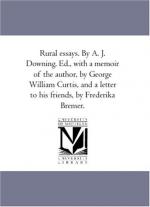
Dictionary of Literary Biography on George William Curtis
George William Curtis (24 February 1824-31 August 1892), critic and social commentator, was born at Providence, Rhode Island. After failing the entrance examination for Brown University in 1838, Curtis worked in a New York importing house but soon tired of it. What he really wanted to try was literature. Curtis looked towards the Brook Farm community as holding out the best hope for his future; there he planned both to earn a living and to pursue his literary interests. He and his brother Burrill arrived at Brook Farm in May 1842. Although he was able to write, publishing poems in the Transcendentalists' periodical, the Dial, and in the Brook Farm's Harbinger, Curtis tired of life at the community. Put off by "a selfish and an unheroic aspect" he saw in the Brook Farmers' lives, Curtis left for New York in 1843. The next year he joined Burrill to live in Concord, where he formed a fast friendship with Ralph Waldo Emerson and met Henry David Thoreau. Curtis stayed in Concord, except for the winter of 1845, until 1846, when he sailed for Europe. Over the next four years Curtis travelled on the continent and in Egypt, briefly sending travel letters to the Harbinger. Upon his return to New York in 1850, Curtis took employment with the New-York Tribune and began writing up his travels in book form. In 1851 and 1852 he published three books based on his wanderings and all were well-received.
Curtis helped found Putnam's Monthly (1853-1857) and served as an editor. For Putnam's he accepted a number of contributions by Herman Melville and Thoreau. The latter proved bothersome and their relationship was strained when Curtis deleted passages from Thoreau's "A Yankee in Canada" because of their "defiant pantheism" without consulting the author first. Curtis also contributed regularly to such major journals as Harper's Weekly and Harper's Monthly, began a very successful lecture career, and published Potiphar Papers, a satirical sketch of New York society. In 1854 he began contributing the "Editor's Easy Chair" column to Harper's Monthly, a column he wrote until 1892. Although he married the socially prominent Anna Shaw in 1856, Curtis continued to be an outspoken supporter of unpopular issues, such as woman's suffrage and anti-slavery. Curtis was by now well-established and spent his remaining years commenting on the literary scene rather than contributing new works to it. For the next thirty years Curtis wrote numerous articles on literature in a number of journals and became active in Republic Party politics, campaigning extensively for civil service reform. His social and literary efforts were recognized by an honorary Master of Arts degree from the University of Rochester in 1852, an honorary Doctor of Laws degree from Madison University in 1864, an appointment as vice-chancellor (1886) and chancellor (1890) of the University of the State of New York, and the publication of his collected works in 1856 and 1863. When he died on Staten Island, New York, there was a brief flurry of interest in his writings, but from the next decade on he was studied more by historians than by literary critics. As the dates of Curtis's collected works indicate, most of his original writing was done early in his life. His travel books are marked by a florid style and sentimentality, yet contain well-conceived individual scenes; his satirical writings, though dated by topical references, still ring true in their portrayal of human foibles. Curtis's literary studies, of which there are many because of the monthly columns he wrote in Harper's for over thirty years, are correct and conventional, reflecting very much the opinions of his contemporaries and not breaking new grounds or establishing original critical standards.
This is the complete article, containing 612 words
(approx. 2 pages at 300 words per page).

