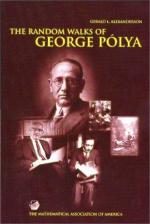
The career of George Pólya was distinguished by the discovery of mathematical solutions to a number of problems originating in the physical sciences. He made contributions to probability theory, number theory, the theory of functions, and the calculus of variations. He also cared about the art of teaching mathematics; he worked with educators, advocating the importance of problem solving, for which the United States gave him a distinguished service award. Pólya continued to do innovative research well into his nineties, but he is probably best known for his book on methods of problem solving, called How to Solve It, which has been translated into many languages and has sold more than one million copies.
Pólya was born in Budapest, Austria-Hungary (now Hungary), on December 13, 1887, the son of Jakob and Anna Deutsch Pólya. As a boy, he preferred geography, Latin, and Hungarian to mathematics. He liked the verse of German poet Heinrich Heine and translated some into Hungarian. His mother urged him to become a lawyer like his father, and he began to study law at the University of Budapest, but soon turned to languages and literature. He earned teaching certificates in Latin, Hungarian, mathematics, physics, and philosophy, and for a year he was a practice teacher in a high school. Though physics and philosophy interested Pólya, he decided to study mathematics on the advice of a philosophy professor. In an interview published in Mathematical People: Profiles and Interviews, Pólya explained how he chose a career in mathematics: "I came to mathematics indirectly.... It is a little shortened but not quite wrong to say: I thought I am not good enough for physics and I am too good for philosophy. Mathematics is in between."
Pólya received his doctorate in mathematics from the University of Budapest in 1912 at the age of 24 with a dissertation on the calculus of probability. Traveling to Germany and France, he was influenced by the work of eminent mathematicians at the University of Göttingen and the University of Paris. In 1914, he took his first teaching position, at the Eidgenössische Technische Hochschule in Zurich, Switzerland; he taught there for twenty-six years, becoming a full professor in 1928.
During World War I, Pólya was initially rejected by the Hungarian Army because of an old soccer injury. When the need for soldiers increased later in the war, however, he was asked to report for military service, but by this time he had been influenced by the pacifist views of British mathematician and philosopher Bertrand Russell and refused to serve. As a result, Pólya was unable to return to Hungary for several years, and he became a Swiss citizen. He married Stella Vera Weber, the daughter of a physics professor, in 1918.
Pólya proved an important theorem in probability theory in a paper published in 1921, using the term "random walk" for the first time. Many years later, a display demonstrating the concept of a random walk was featured in the IBM pavilion at the 1964 World's Fair in New York; it recognized the work of Pólya and other distinguished scholars. Pólya's work with Gabor Szegö, also a Hungarian, resulted in Problems and Theorems in Analysis, published in 1925. The problems in the book were grouped not according to the topic but according to the methods that could be used to solve them. Pólya and Szegö continued to work together and they published another book, Isoperimetric Inequalities in Mathematical Physics, in 1951.
Pólya was awarded the first international Rockefeller Grant in 1924 and spent a year in England at Oxford and Cambridge, where he worked with English mathematician Godfrey Harold Hardy on Inequalities,Inequalities which was published in 1934. During the 1930s, Pólya frequently visited Paris to collaborate on papers with Gaston Julia. He received another Rockefeller Grant in 1933, this time to visit the United States, where he worked at both Princeton and Stanford universities. In 1940, after World War II had begun in Europe, Pólya left Switzerland with his wife and emigrated to the United States. He taught for two years at Brown University and for a short time at Smith College before joining Szegö at Stanford University in 1942, where he would remain until his retirement in 1953 at age 66. Pólya became a U.S. citizen in 1947.
Before leaving Europe, Pólya had begun writing a book on problem solving. Observing that Americans liked "how-to" books, Hardy suggested the title How to Solve It. The book, Pólya's most popular, was published in 1945; it examined discovery and invention and discussed the processes of creation and analysis. Although he officially retired in 1953, Pólya continued to write and teach. Another book on heuristic principles for problem solving, at a more advanced level of mathematics, was published in 1954, entitled Mathematics and Plausible Reasoning.A third book on problem solving, Mathematical Discovery, was published in 1962. In 1963, Pólya was the recipient of the distinguished service award from the Mathematical Association of America. The citation, as quoted in the Los Angeles Times, read: "He has given a new dimension to problem-solving by emphasizing the organic building up of elementary steps into a complex proof, and conversely, the decomposition of mathematical invention into smaller steps. Problem solving a la Pólya serves not only to develop mathematical skill but also teaches constructive reasoning in general."
Pólya also became interested in the teaching of mathematics teachers, and he taught in a series of teacher institutes at Stanford University supported by the National Science Foundation, General Electric, and Shell. His film, "Let Us Teach Guessing," won the Blue Ribbon from the Educational Film Library Association in 1968. In 1978, the National Council of Teachers of Mathematics held problem-solving competitions in The Mathematics Student; they named the awards the Pólya Prizes.
Pólya made significant contributions in many areas, including probability, geometry, real and complex analysis, combinatorics, number theory, and mathematical physics. Perhaps one indication of the breadth of his accomplishments is the range of fields that now contain concepts bearing his name. For example, the "Pólya criterion" and the "Pólya distribution" in probability theory; and "Pólya peaks," the "Pólya representation," and the "Pólya gap theorem" in complex function theory. Pólya's writings have been praised for their clarity and elegance; his papers were called a joy to read. The Mathematical Association of America established the Pólya Prize for Expository Writing in the College Mathematics Journal. Pólya's papers were collected and published by MIT Press in 1984.
Pólya received honorary degrees from the University of Wisconsin at Milwaukee, the University of Alberta, the University of Waterloo, and the Swiss Federal Institute of Technology. He was a member of the American Academy of Arts and Sciences, the National Academy of Sciences of the United States, the Hungarian Academy of Sciences, the Academie Internationale de Philosophie des Sciences in Brussels, and a corresponding member of the Académie Royale des Sciences in Paris. The Society for Industrial and Applied Mathematics named an honorary award after him, the Pólya Prize in Combinatorial Theory and Its Applications.
Among his colleagues, Pólya was known as a kind and gentle man, full of curiosity and enthusiasm. In honoring him, Frank Harary praised his depth, his versatility, and his speed and power as a mathematician. The mathematician N. G. de Bruijn wrote of Pólya in The Pólya Picture Album: Encounters of a Mathematician: "All his work radiates the cheerfulness of his personality. Wonderful taste, crystal clear methodology, simple means, powerful results. If I would be asked whether I could name just one mathematician who I would have liked to be myself, I have my answer ready at once: Pólya." Pólya suffered a stroke at age ninety-seven and died in Palo Alto, California, on September 7, 1985.
This is the complete article, containing 1,274 words
(approx. 4 pages at 300 words per page).