 Print
Print Word
Word PDF
PDF|
This section contains 2,335 words (approx. 8 pages at 300 words per page) |

|
World of Physics on George Ellery Hale
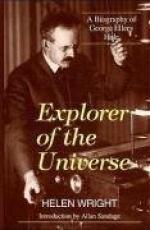
George Ellery Hale was an American astronomer and astrophysicist who pioneered spectroscopic research and the development and use of large telescopes. He is widely considered to be the father of modern solar observational astronomy, and is best known for his discovery in 1908 of the presence of magnetic fields in sunspots. Hale invented new instruments for studying solar and stellar spectra, including the spectroheliograph and the spectrohelioscope, and also founded three of the United States's leading observatories, at Yerkes, Mt. Wilson, and Palomar; the latter two were renamed the Hale Observatories in 1969.
Hale was born on June 29, 1868, in Chicago, Illinois. His father, William Ellery Hale, was a wealthy businessman who manufactured hydraulic elevators; his mother, Mary Scranton Browne, was the daughter of a Congregational minister who later became a doctor. Hale inherited from his mother an intense love of literature. As a child he read Don Quixote, the Iliad...
|
This section contains 2,335 words (approx. 8 pages at 300 words per page) |
|