
BookRags.com Literature Guides Literature
Guides
Criticism & Essays Criticism &
Essays
Questions & Answers Questions &
Answers
Lesson Plans Lesson
Plans
My Bibliography Periodic Table U.S. Presidents Shakespeare Sonnet Shake-Up
Research Anything:        
History | Encyclopedias | Films | News | Create a Bibliography | More... Login | Register | Help

Not What You Meant?  There are 35 definitions for Moore.

George Edward Moore Biography

Print-Friendly  Order the PDF version  Order the RTF version
About 1 pages (424 words)
George Edward Moore Summary

Bookmark and Share Questions on this topic? Just ask!
Name: George Edward Moore
Birth Date: November 4, 1873
Death Date: October 24, 1958
Place of Birth: London, England
Place of Death: Cambridge, England
Nationality: English
Gender: Male
Occupations: philosopher

Encyclopedia of World Biography on George Edward Moore

The English philosopher George Edward Moore (1873-1958) was one of the originators of conceptual and linguistic analysis, the dominant trend in modern English philosophy.

Born on Nov. 4, 1873, in Upper Norwood, a suburb of London, G. E. Moore was the fifth of eight children in a cultivated family. After initial tutoring at home by his father, Moore was sent to a nearby day school, Dulwich College. There he pursued classical studies and music and formed the basis for his fine prose style. Excellence in these studies won him a scholarship to Trinity College, Cambridge, which he entered in 1892.

At Cambridge, Moore discovered philosophy and a wide circle of friends, Bertrand Russell introducing him to both. After completing his degree with a first, Moore won the annual fellowship prize with an essay on Immanuel Kant's ethics. The 6 years of leisure provided by the fellowship enabled Moore to break away from the idealism of J. M. E. McTaggart and F. H. Bradley and to begin to work out his own philosophical views. At the end of this period his first mature work, Principia Ethica (1903), was finished.

After a period of independent scholarship, supported by a comfortable inheritance, Moore was invited back to Cambridge in 1911 as a lecturer in psychology. In 1925 he became professor of philosophy there and held this post until his retirement in 1939. The extraordinary impact Moore had upon his students may be gathered from J. M. Keynes's delightful account in Two Memoirs (1949). After 1929 Moore attended Ludwig Wittgenstein's lectures and Wittgenstein attended Moore's; between them the two philosophers fundamentally altered the character of English philosophy.

Moore's work is essentially one of analysis and criticism. He has aptly characterized his interest in philosophy as follows: "I do not think that the world or the sciences would ever have suggested to me any philosophical problems. What has suggested philosophical problems to me is things which other philosophers have said about the world or the sciences." He is thus a philosopher's philosopher. He taught his pupils patient and painstaking analysis of concepts, of claims, and, in particular, of their linguistic expression. Moore had a passion for clarity and propriety of usage; he also insisted on the rights of common sense, not as the ultimate norm but as one important basis for criticism, not to be lightly dismissed.

After retirement Moore lectured widely in the United States until 1944. He died on Oct. 24, 1958, in Cambridge, England. His principal works include Philosophical Studies (1922), Some Main Problems of Philosophy (1953), and Philosophical Papers (1959).

This is the complete article, containing 424 words (approx. 1 page at 300 words per page).

View More Summaries on George Edward Moore
More Information
  • View George Edward Moore Study Pack
  • 35 Alternative Definitions
  • Search Results for "George Edward Moore"
  • Add This to Your Bibliography
  • More Products on This Subject
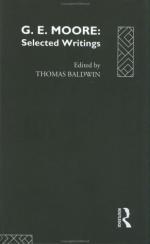
    G. E. Moore
    G. E. Moore is known for his attack on idealism and defense of common-sense realism and for being, ... more

    Moore, G(Eorge) E(Dward)
    (born Nov. 4, 1873, London, Eng.—died Oct. 24, 1958, Cambridge, Cambridgeshire) British philo... more


    Ask any question on George Edward Moore and get it answered FAST!
    Answer questions in BookRags Q&A and earn points toward
    discounted or even FREE Study Guides and other BookRags products!
    Learn more about BookRags Q&A
    Copyrights
    George Edward Moore from Encyclopedia of World Biography. ©2005-2006 Thomson Gale, a part of the Thomson Corporation. All rights reserved.

    Join BookRagslearn moreJoin BookRags


    About BookRags | Customer Service | Report an Error | Terms of Use | Privacy Policy

